

Oolong tea is one of the broadest and most complex categories in the world of tea. The name covers teas with an extraordinarily wide range of profiles, from floral notes to more roasted ones. It all depends on the terroir, the cultivars and the production process, which is remarkably varied.
Below we answer some of the most frequently asked questions about Oolong tea, also popularly known as blue tea.
If you like, you can leave your questions about Oolong in the comments, and we will try to expand this post by answering them.
What is Oolong tea?
Oolong tea is one of the major categories of tea made from Camellia Sinensis, the same plant that green, white, yellow, black and dark teas come from.
The word Oolong comes from wūlóng (乌龙), which literally means “black dragon”. The spelling Oolong became popular internationally, although Wulong is the pinyin romanisation currently used for the Chinese term.
What sets these teas apart is their production method, which is mainly characterised by withering the leaves, bruising them in a controlled way to promote oxidation and then stopping that oxidation with heat.
This technique gives it exceptional sensory diversity.
How is Oolong tea produced?
Producing an Oolong can be considerably complex and varies depending on the region and style.
Generally speaking, it begins with a harvest of leaves that are usually more mature than those used for many green teas. They are then withered, often combining periods outdoors and indoors.
Next comes one of the processes that defines Oolong, in which the leaves are gently shaken, tossed or bruised to damage certain areas, especially the edges. This starts oxidation. They are then left to rest, and the cycle of shaking and resting can be repeated many times until the desired profile is achieved.
When the producer considers the oxidation to be sufficient, heat is applied to stop it. Finally, the leaves are rolled or shaped, dried and, in certain styles, roasted afterwards.
What does Oolong tea taste like?
This is precisely one of the hardest questions to answer because its aromatic diversity is enormous.
Depending on the tea, we can find notes of:
- Orchid and other flowers.
- Gardenia.
- Lilac.
- Peach and apricot.
- Tropical fruit.
- Honey.
- Butter and cream.
- Vanilla.
- Nuts.
- Caramel.
- Toasted cereals.
- Cocoa.
- Spices.
- Wood.
- Wet stone and mineral notes.
Greener Oolongs tend to show a floral, vegetal and creamy profile. More oxidised ones can offer more ripe fruit and honey, while a deep roast adds new layers of nuts, caramel, wood, or cocoa.
This breadth is precisely one of the characteristics that best defines this wonderful tea family.
What does it mean that Oolong is a semi-oxidised tea?
It means that during production, the enzymatic oxidation of the leaves is deliberately started and stopped at the point chosen by the producer.
This is why expressions such as “partially oxidised” are also used.
Oxidation begins when handling the leaves breaks some of their cells and allows certain compounds to come into contact with enzymes and oxygen. In Oolong, this process is carefully controlled before heat is applied to stop it.
The important thing to understand is that semi-oxidised does not necessarily mean 50% oxidised. An Oolong can have relatively light or very high oxidation and still belong to this category.
What percentage of oxidation does Oolong tea have?
There is no single standard percentage of oxidation in Oolong tea production.
As a rough guide, we can find Oolongs with levels that usually fall approximately between 10% and 80%, although certain styles may even fall outside that range.
Very green, floral Oolongs have relatively low oxidation, while styles such as Oriental Beauty can reach considerably higher levels.
But these percentages should be interpreted with some caution. There is no universal, analytical international scale that allows all Oolongs to be labelled as being exactly 25% or 60% oxidised. In many cases, they are estimates used by producers and traders to describe the style.
Moreover, two Oolongs with a similar level of oxidation can taste completely different due to the cultivar, terroir, harvest, processing method and roasting.
What is the difference between Oolong tea and green tea?
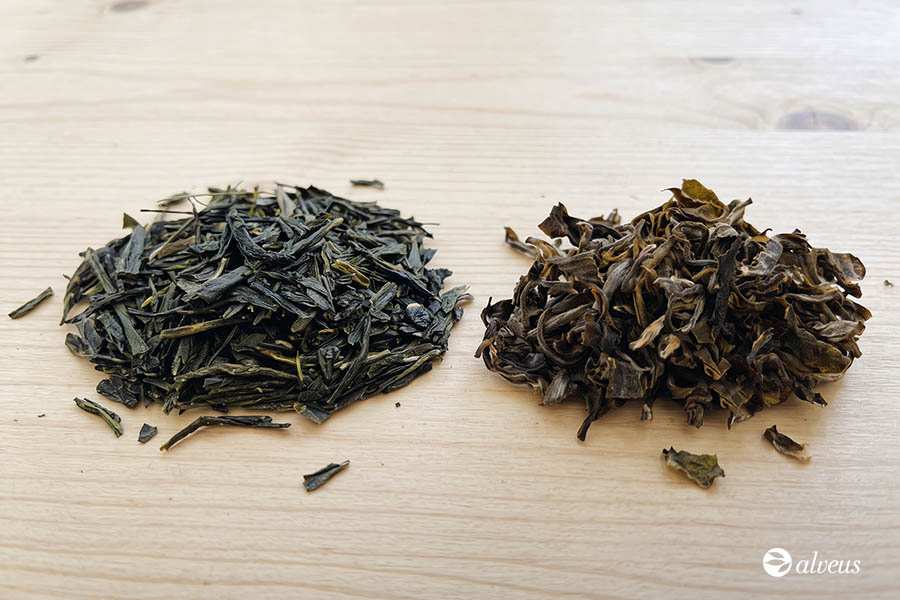
The main difference between an Oolong tea and a green tea lies in how oxidation is controlled.
In green tea, the leaves are heated relatively soon after harvesting to deactivate the enzymes responsible for oxidation.
In Oolong, on the other hand, they are first withered and handled to deliberately promote controlled oxidation. Only once the desired point has been reached is heat applied to stop it.
This allows many Oolongs to develop a different aromatic complexity, with floral, creamy, fruity, honeyed, mineral or roasted notes.
However, some very lightly oxidised Oolongs can be reminiscent of green tea on the palate, which partly explains the confusion between the two categories.
What is the difference between Oolong tea and black tea?
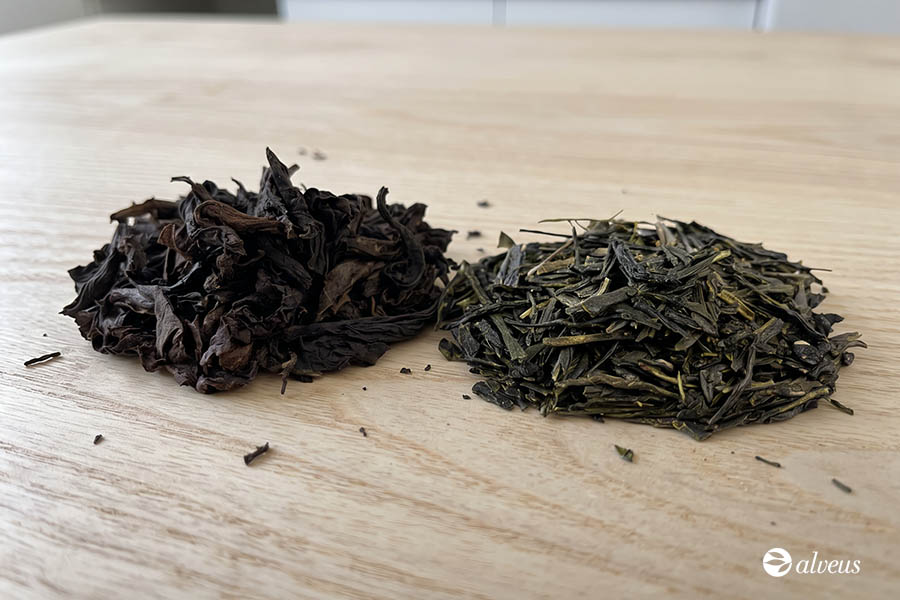
Once again, the main difference between an Oolong tea and a black tea lies mainly in how oxidation is managed.
During the production of black tea, the leaves are rolled, broken or macerated to encourage very extensive oxidation before drying.
With Oolong, the producer seeks to control this transformation and stop it at a specific point. In addition, the leaves are usually handled in such a way that certain areas oxidise more than others.
Is Oolong tea a green tea or a black tea?
Neither. Oolong is a category in its own right among teas made from Camellia Sinensis.
The confusion arises because its oxidation can fall between the levels typically found in green and black teas. An Oolong also follows a distinctive production sequence, especially the repeated process of withering, bruising, resting and controlled oxidation.
That is why a lightly oxidised Oolong does NOT become a green tea, and a highly oxidised one does not automatically become a black tea.
What are the main types of Oolong tea?
One of the most common ways to classify Oolong tea is by its main producing areas.
Anxi, in southern Fujian. It is particularly known for Tie Guan Yin and other rolled-leaf Oolongs.
Wuyi, in northern Fujian. This is home to the famous Yancha or “rock teas”.
Phoenix or Fenghuang Mountains, in Guangdong. This is where the renowned Dan Cong are made.
Taiwan. It produces an extraordinary diversity of styles, including Dong Ding, Baozhong, Oriental Beauty and numerous Gaoshan Cha or high-mountain teas.
There are also Oolongs made in other regions of China and in countries such as Thailand, Vietnam, India, and Nepal.
What are the most popular Oolong teas?
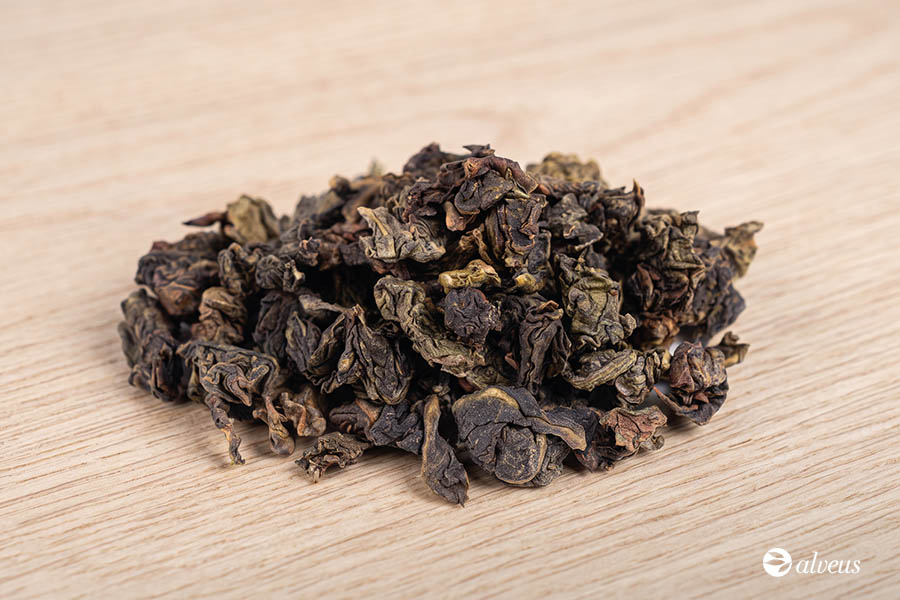
Tie Guan Yin – Reference 89112 by Alveus
There are hundreds of Oolongs, but some styles have become international benchmarks.
Tie Guan Yin. Originating in Anxi, Fujian, it is one of the best-known names in the category. The name refers both to a cultivar and to the teas made from it. Green, very floral versions are common today, although styles with more pronounced oxidation and roasting were also traditionally produced.
Da Hong Pao. One of the most famous Oolongs from the Wuyi Mountains. Its name means “Big Red Robe”, and it is surrounded by numerous stories and legends. Current commercial versions can vary considerably depending on cultivar, blending, oxidation and roasting.
Wuyi Yancha. Rather than a single tea, it is a family of Oolongs from Wuyi. Yancha roughly means “rock tea” and includes styles such as Shui Xian, Rou Gui and Da Hong Pao. They are known for their structure, complexity, mineral character and frequent roasted notes.
Dan Cong. The Oolongs from Fenghuang or Phoenix, in Guangdong, stand out especially for their enormous aromatic intensity. Different types can be reminiscent of orchid, honey, tropical fruit, citrus, spices or stone fruit.
Dong Ding. One of the great historic names in Taiwanese Oolong, traditionally associated with Nantou. Its leaves are usually rolled, and versions range from fairly green to more deeply roasted styles.
Oriental Beauty or Bai Hao Oolong. One of Taiwan’s most unique Oolongs. The leaves are bitten by small insects known as tea green leafhoppers, which triggers defensive chemical responses in the plant that contribute to its characteristic sweet, honeyed and fruity profile. It is also an Oolong with fairly high oxidation.
Also worthy of special mention are Wenshan Baozhong and Taiwanese High Mountain Oolong or Gaoshan Cha from areas such as Alishan and Lishan.
Where is the best Oolong tea produced?
There is no objective answer because it depends on the style we are looking for.
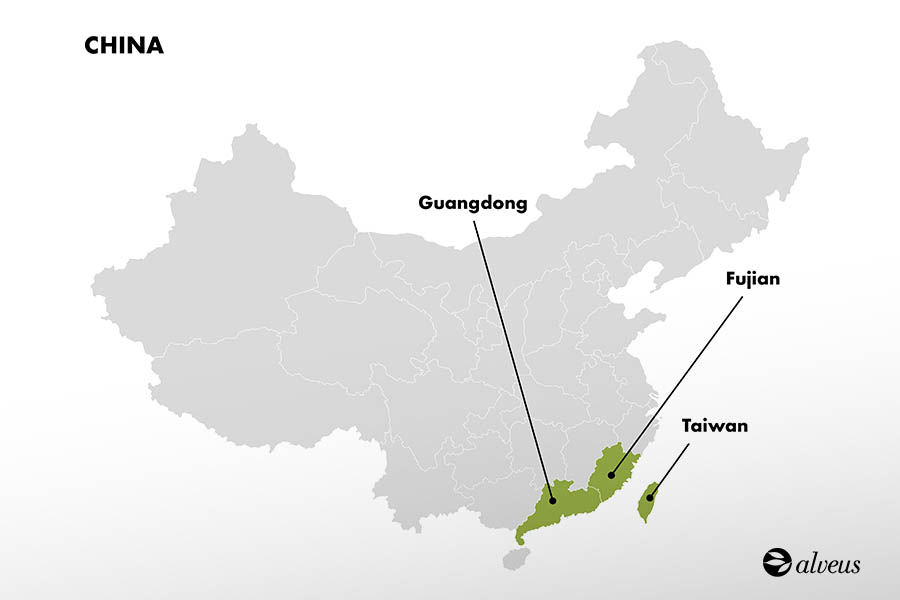
Fujian, Guangdong and Taiwan are the three great historical benchmarks.
If we are looking for a floral, fragrant Oolong, we can find excellent options in Anxi or in the mountains of Taiwan.
For mineral, roasted and structured profiles, Wuyi is one of the most prestigious regions.
Lovers of very intense floral and fruity aromas often find some of the most interesting Oolongs in the world among the Dan Cong of Guangdong.
And Taiwan stands out especially for its mountain Oolongs, where altitude, cultivars and extraordinary precision in production can result in highly aromatic, richly textured cups.
What are the differences between Chinese and Taiwanese Oolongs?
The Oolong teas easiest to find on the market are those produced in China and Taiwan. A common question is how the two differ.
It should be said that China has some of the most important historical traditions and enormous regional diversity. Within China itself, we find styles as different as a Tie Guan Yin from Anxi, a Yancha from Wuyi or a Dan Cong from Guangdong.
Taiwan developed its own Oolong culture from techniques and plant material historically linked to Fujian, but over time created styles with their own distinctive stamp.
Many Taiwanese mountain Oolongs are relatively lightly oxidised, floral, sweet and creamy in texture, with rolled leaves. However, it is impossible to generalise: Oriental Beauty, for example, is a fairly oxidised Taiwanese Oolong with a completely different profile.
What are the differences between an Anxi Oolong and a Wuyi Oolong?
Anxi and Wuyi Oolongs are two great Fujian traditions, but they are very different from each other.
Anxi Oolongs, such as Tie Guan Yin, usually have leaves rolled into small, compact shapes. Many current styles stand out for intense floral aromas, fresh vegetal notes, butter, cream and a clean, sweet sensation.
Wuyi Oolongs or Yancha usually retain a longer, twisted leaf. Their profiles can show ripe fruit, wood, cocoa, spices, nuts, roasted notes and a characteristic mineral sensation.
In addition, roasting has traditionally been of great importance in many Wuyi Oolongs.
Why are some Oolongs floral and others roasted or mineral?
The flavour of an Oolong tea does not depend solely on how much the leaf has been oxidised. It also depends on its cultivar, the terroir, the producer’s technique and, in some cases, roasting.
The cultivar largely determines its aromatic potential. Some naturally produce more floral, fruity or spicy profiles.
Terroir also plays a role. Soil, altitude, temperature, humidity, exposure and growing conditions all contribute to the tea’s expression. In Wuyi, for example, the relationship between the rocky environment and the profile of Yancha is a fundamental part of their identity.
Added to this are the producer’s decisions during withering, shaking, oxidation, fixing and drying.
Finally, roasting can profoundly transform the original profile. That is why two lots made from the same cultivar can end up offering completely different sensory experiences.
What does it mean when an Oolong is roasted?
It means that, after the main stages of production and drying, the tea undergoes an additional application of heat, which darkens its leaves.
Well-executed roasting can:
- Reduce certain vegetal notes.
- Soften certain rough edges.
- Increase the sense of body.
- Develop nutty and cereal aromas.
- Create notes of caramel, wood, cocoa, or spices.
- Add greater depth and complexity.
The intensity can be light, medium, or deep, and some Oolongs undergo several cycles of roasting and resting.
Why do some Oolong teas have leaves rolled into balls?
Because during rolling, they undergo a repeated process of kneading and compression.
Traditionally, the leaves are placed in a cloth that is closed to form a kind of bundle. This is squeezed and kneaded, then opened to separate the leaves, and the process starts again.
Little by little, the leaves take on that characteristic compact shape.
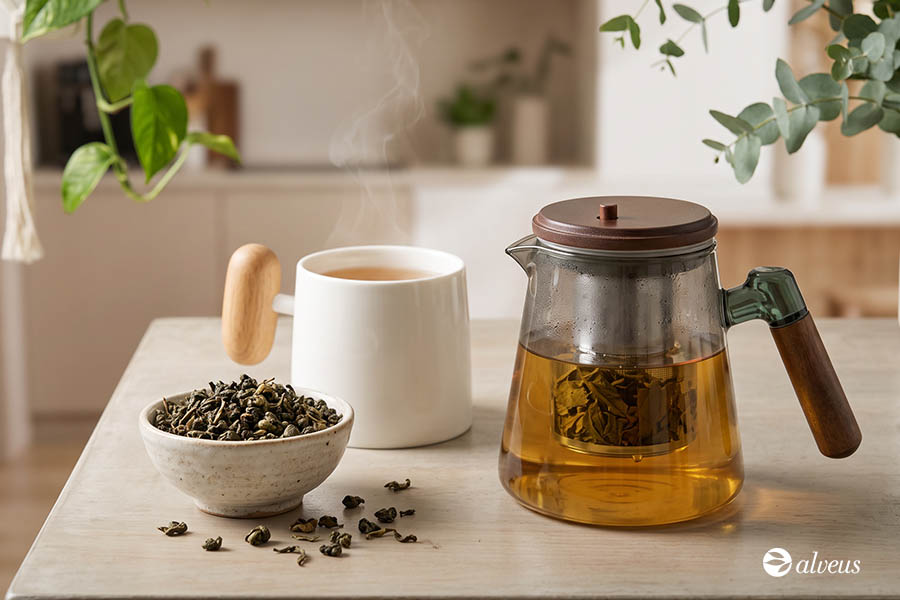
These are not small balls made from crushed leaves. Each one can contain a large leaf that unfurls and regains a surprising size when it comes into contact with water.
This style is especially common in many Oolongs from Anxi and Taiwan.
How do you brew Oolong tea correctly?
Brewing Oolong tea should be adapted to the style, as a green, floral Oolong does not behave in the same way as a more oxidised or roasted one. As a general guide, you can use 2.5–4 grams of tea per 250 ml of water, at temperatures of between 80 and 100 °C. More delicate styles tend to work better at the lower end of that range, while Yancha, Dan Cong or more roasted Oolongs can take higher temperatures.
For Western-style brewing, a time of 2 to 4 minutes is usually enough. It is also a category particularly well suited to the Gongfu method, using more leaf and less water, for example 5–7 grams per 100 ml, with initial infusions of just a few seconds that are gradually lengthened.
The best advice for brewing it correctly is to observe how each tea responds. If the cup is too intense or astringent, reduce the time or temperature. If it tastes flat, slightly increase the amount of leaf or the water temperature.
How many times can Oolong tea be infused?
Whole-leaf Oolongs are among the teas that respond best to successive infusions.
With Western-style brewing, it is common to get two, three, or even four good infusions depending on the Oolong. With Gongfu brewing, a quality Oolong can provide five, eight or more infusions.
How much caffeine does Oolong tea contain?
There is no fixed amount of caffeine that can be attributed to all Oolong teas. Its content depends on the cultivar, the harvest, and the leaves used, while the amount that ends up in the cup is largely determined by the tea dosage, the water temperature and the infusion time.
A large study carried out in China analysed 1,398 samples of different types of tea and found that the Oolongs studied contained an average of approximately 27 mg of caffeine per gram of dry leaf. This figure shows the presence of caffeine in the raw material, but does not directly tell us how much there will be in a particular cup, as that depends on how the tea is prepared.
Preparation can significantly alter that extraction. In a study published in 2025, an Oolong sample brewed for two minutes went from approximately 4 mg of caffeine per 200 ml at 80 °C to 14 mg per 200 ml at 100 °C. The authors also observed that lengthening the infusion time increased the amount extracted.
What are the properties and benefits of Oolong tea?
Oolong contains polyphenols, caffeine, L-theanine and various compounds that are formed or transformed during oxidation. Its possible relationship with glucose metabolism, lipids and fat oxidation has been a particular focus of research. However, clinical research specifically on Oolong remains relatively limited, and some results are contradictory.
In a small crossover trial with 20 people with type 2 diabetes, drinking 1.5 litres of Oolong a day for 30 days was associated with a reduction in glucose and fructosamine. See study on PubMed
However, another controlled trial in healthy adults found no significant improvements in glucose or insulin after drinking Oolong, which shows that we cannot generalise that result or consider tea a treatment for diabetes. See study on PubMed
Its relationship with energy metabolism has also been studied. In a randomised, double-blind, crossover trial with 12 healthy men, drinking Oolong for two weeks increased fat oxidation by approximately 20% under the experimental conditions, although it did not produce a significant increase in total 24-hour energy expenditure. The result is interesting from a metabolic point of view, but it does not prove that drinking Oolong causes weight loss. See study on PubMed
There is also preliminary research on cardiovascular health. A small crossover study with 22 patients with coronary artery disease observed favourable changes in some markers, such as adiponectin and LDL particle size, after one month of drinking Oolong. See study on PubMed
Overall, Oolong can be part of a healthy diet and provides bioactive compounds of interest, but the available evidence does not allow us to attribute therapeutic properties to it or to claim that it prevents or treats disease.