

All of us who love tea are constantly coming up with ideas for creating our own blend, right? They can be sparked by tasting a dessert, by a trip, a seasonal ingredient, a trend… or even by a feeling we want to recreate in the cup:
“I want a tea that’s reminiscent of a lemon cake”
“I want a fresh, Mediterranean herbal infusion”
“I want a blend that matches my brand’s personality”
Turning that initial intuition into a successful blend requires looking at several aspects. It has to be appealing when the pack is opened, work in the cup, keep a recognisable profile, be possible to produce again a few months later and make sense for the business that will sell it.
That is the difference between “an idea and a dream” and a product ready to go to market.
A good flavour idea is not yet a product
When developing personalised blends, we often start from very different concepts. Sometimes the client arrives with a fairly precise description. At other times there is only a vague idea, which might be a flavour, an emotion, a colour or the type of consumer they want to target.
Both starting points are valid.
What matters is turning that information into decisions that can be translated into a recipe.
Let’s imagine a brand that intends to create a tea inspired by a lemon tart. If the client has little experience, they will think that is enough for us to develop their blend, but to make it unique, we need much more information. To do so, and following this example, we would ask the following questions:
- Would you like it to include a particular ingredient for any reason?
- Should the texture be creamy or more citrusy?
- Are you looking for a sweet sensation?
- Should it evoke lemon zest, lemon juice or lemon curd?
- Do we want a black tea base that adds body or a fresher green tea?
- Should it be a year-round product or have a more summery character?
That’s why, before choosing ingredients, it’s worth defining the experience we want to achieve.
Understanding what product we want to sell before formulating the recipe
Many clients tend to give the instruction that “it should taste good”. Unfortunately, as we saw in the previous section, this information alone is not enough.
We need to know who is going to buy it, where it will be sold, what position it will hold within the range and what role it will play for the brand.
Developing a recipe intended to become a shop’s flagship product is not the same as preparing a limited Christmas edition. Nor should a premium tea for a specialist brand be approached in the same way as a product designed to reach a very broad audience.
The consumer profile will shape many subsequent decisions.
Every brand and shop is different. Some look for traditional flavours, others for less common recipes that in some way reinforce their personality. A loose-leaf tea shop places great value on a spectacular appearance, both visually and aromatically, while an e-commerce business wants the product to photograph well and lend itself to good storytelling.
How to define the flavour of a personalised tea blend
“Elegant”, “refreshing”, “Mediterranean”, “sweetish” or “sophisticated” are adjectives that often accompany a request for a personalised blend, but by now you’ll understand that they are not formulation instructions.
They need to be interpreted.
A refreshing profile could be built with citrus, mint, lemongrass or certain green tea bases. A sweet sensation could rely on cocoa, vanilla, nuts or certain aromatic profiles. A Mediterranean idea could lead us towards rosemary, citrus, herbs, or flowers.
But none of these ingredients should be added simply because it fits the concept on paper. You have to think about what it will actually bring to the cup.
This is even more important when a brand wants to develop a product associated with a well-known flavour. A brownie, a cocktail, a tropical fruit or a dessert can contain many different aromatic notes. If we try to include all of them, the result can be a confusing flavour.
The choice of base shapes the whole blend
One of the first steps in creating a personalised tea blend is deciding which base it will be built on.
Black, green, white, oolong, pu-erh, rooibos, honeybush or a herbal blend: each brings a very different personality.
Black tea usually offers more body and works well with intense, spiced, roasted or sweet profiles. A green tea can provide freshness and vegetal notes that suit citrus, floral or fruity profiles better. Rooibos opens up interesting possibilities when you are looking for a caffeine-free drink with a naturally sweet character.
But these associations should not be taken as rules. What matters is checking how that particular base interacts with the rest of the formulation.
A strawberry can come across very differently on a Sencha than on a black tea. Vanilla can round off one base and be overpowering in another. Even an ingredient as recognisable as lemon can be perceived differently depending on the tea it is paired with.
The base is not simply the support for the blend. It is part of its flavour.
How to choose the right ingredients for a blend
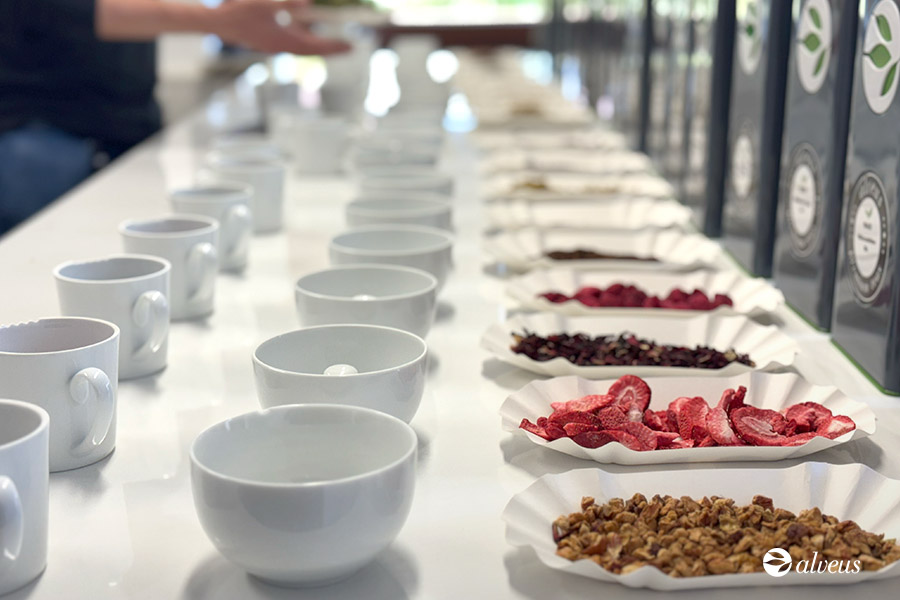
One of the most common mistakes when imagining a new blend is to equate quality with the number of ingredients.
A blend can have any number of ingredients, but having more does not make it a better blend.
In a professional recipe, each component should serve a purpose. Some build the main flavour. Others introduce subtle nuances. Some add colour and visual presence. Others change the mouthfeel or help connect different aromatic profiles.
When an ingredient adds nothing noticeable or does not contribute to the look we are after, it is worth asking why it is there. Not least because it also has a commercial impact, since fruits, flowers, herbs, and spices all differ in cost, availability, and behaviour.
When it comes to aroma, it is not enough for it to be appealing when the pack is opened. It must blend in with the base and the other ingredients and, above all, keep its personality once brewed. The aim is to achieve consistency between what the consumer perceives in the dry blend and what they then find in the cup, avoiding very intense aromas that create an expectation the flavour cannot meet.
When the product needs to be ORGANIC, the choice of ingredients and flavourings is also determined by the certification requirements and by the availability of suitable raw materials.
An ingredient that would work perfectly in a conventional recipe may not be available in the quality, certification, or volume required for the ORGANIC project. At other times, certain elements will need to be adapted to maintain the desired sensory profile.
Tasting is where the idea meets reality
Once the composition has been defined, it may seem perfect, but… tasting is what will determine the outcome of the blend.
During development, aroma, flavour, body, colour, balance and finish all need to be assessed. It is also worth observing what happens as the infusion cools, because the profile of certain ingredients changes considerably.
When tasting it, you may find that the main note comes through too late, that the flavour meant to linger on the finish fades too quickly, or even that there is a considerable difference between the dry and brewed aroma.
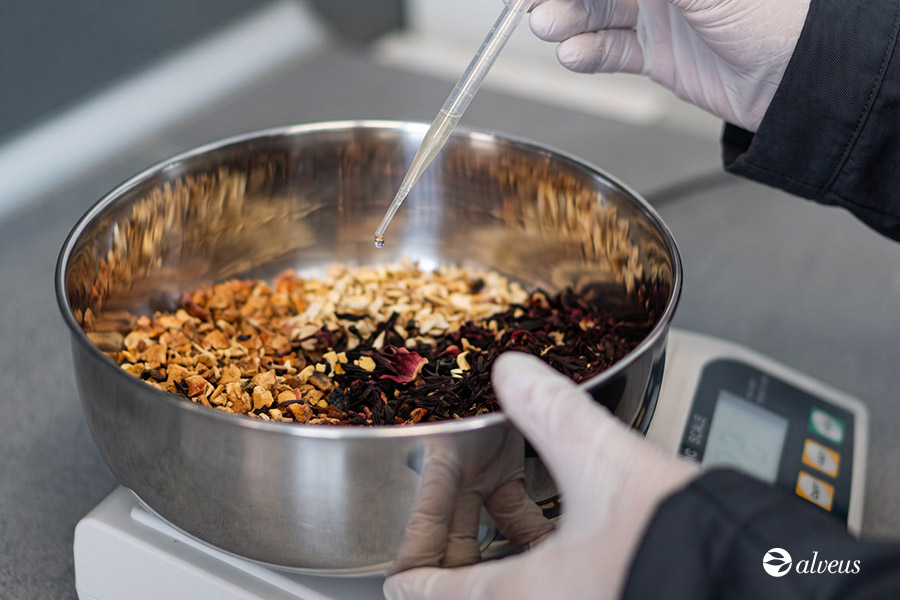
After tasting, the adjustment process begins, which may involve increasing or reducing quantities or ingredients. Developing a good blend involves a fair amount of trial, observation and patience. It is formulated, prepared, tasted, corrected and tasted again.
A professional recipe has to be repeatable
Let’s suppose a blend is very well received. Customers try it, buy it again and over time it becomes a key product for the brand. This means that the next production run has to match the previous one.
This is where the purchasing department’s work is vital. They must find raw materials similar in cut, flavour, and appearance. When selecting ingredients, they also need to make sure there will be future availability at any time of year.
Sourcing thus becomes part of product development.
Alveus applies this principle through its knowledge of the origins, availability, and behaviour of raw materials, precisely so that projects can be sustained beyond an initial production run.
From prototype to real production
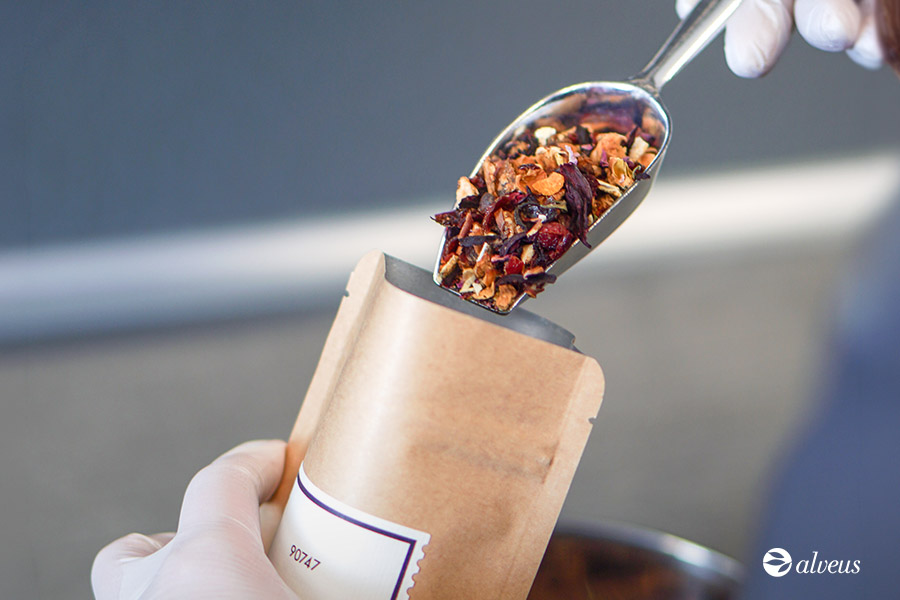
A small sample makes it possible to validate the idea, but to turn it into a marketable product, the recipe must also work on a larger scale. As volumes increase, it is essential to keep the blend homogeneous, respect the parameters defined during development and ensure the blend’s profile is preserved. That’s why the ideal approach is to start with a manageable production run that allows you to test how it is received and, if it works, to grow afterwards without having to rethink the product.
This flexibility is particularly important for young brands. It allows them to launch a product without committing to a disproportionate production run from the outset and, at the same time, avoids having to rethink the whole product when sales start to grow.
When a blend is ready to go to market
A blend is not finished simply because it works well in the cup. Other factors are needed for it to make sense for the business that will sell it: fitting its audience, positioning and price range, standing out within the range and relying on raw materials whose availability allows the recipe to be maintained over time. Even appearance can be more or less important depending on whether it will be sold loose, through an online shop or in its own packaging.
We can consider a recipe ready when it offers a recognisable, balanced profile, delivers on the idea it was born from and can be reproduced while keeping its identity. That is the moment when an inspiration stops being merely an attractive combination of flavours and becomes a product with a strong chance of reaching the market and growing.
At Alveus, we develop personalised blends, supporting each project from the very first idea and the selection of raw materials through to formulation, tasting, assessment of commercial viability and final production. Have an idea for a new blend? Tell us what you have in mind, and we’ll work with you to turn it into a recipe of your own, ready for your business.