


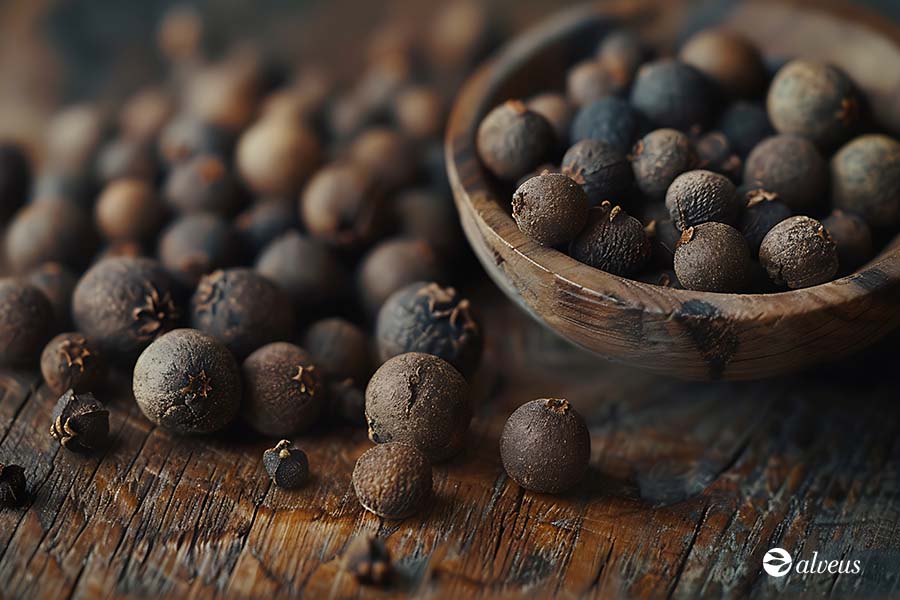
This small, dark, dried berry has an unusually complex aroma.
Simply crush a grain between your fingers to release a warm fragrance with numerous nuances of different spices.
It adds depth without overpowering, rounds off spicy mixtures without overloading them, and works just as well in a marinade as it does in an apple compote or a winter infusion. If it is also stored properly, it becomes one of those products that build customer loyalty, because once customers try it, they start to find a place for it in everything.
What is allspice?
Allspice, also called English pepper, is not a blend, as the latter name might suggest. It is the dried berry harvested green (not fully ripe) from the Pimenta dioica tree, of the myrtle family.
That nuance of “harvested green” matters a lot in the final result. At that stage, the fruit concentrates aromatic compounds which, if dried properly, remain trapped inside the grain and give it that characteristic warm and rounded flavour.
Aroma and flavour of allspice
If your customer asks you what allspice tastes like, the simplest way to describe it is this:
The aroma is reminiscent of cloves, cinnamon and nutmeg.
On the palate, it is warm, slightly sweet, with a smooth finish that may be reminiscent of pepper, but without the direct hit of black pepper.
This makes it a “bridge” spice. It brings ingredients together, rounds out sauces and adds depth without being overpowering.
Where it comes from and how it is processed
The quality of allspice begins at the moment of harvest. The berries are picked when they are still green and firm, before they are fully ripe. At this point, the fruit concentrates a large part of its aromatic compounds. They are then carefully dried until they acquire their characteristic brown colour.
Commercially, it is usually found in the Caribbean and Central America. Jamaica is the origin most associated with this spice due to tradition and its aromatic reputation, but there are also very interesting productions in other countries.
For a professional buyer, rather than pursuing a specific “name”, the important thing is to work with a supplier who guarantees good selection, cleanliness, traceability and a rotation that keeps the aroma alive.

Use whole grain or ground?
Whole grains retain their aroma longer because the essential oils are protected inside the husk. When sold in bulk, this translates into a more consistent experience for the customer and fewer complaints, such as “it doesn’t smell like anything”.
In addition, whole grains allow for very clean professional uses. They can be infused into broths, marinades, pickles or drinks and removed at the end, leaving no gritty texture or excess intensity.
If you sell to the end consumer, allowing them to see the whole peppercorns and inviting them to smell them adds an emotional component.
How to assess quality when buying allspice
For a product to work in a shop, it must always be of high quality, which is why we want to share with you the most important indicators you should know about this spice.
In terms of appearance, the peppercorns should be whole, fairly uniform, without excess loose powder and with few breaks. When they are too broken, the aroma evaporates more quickly and the product ages faster in the dispenser.
The colour should be a uniform brown, without dull or grey tones. The simplest test you can do is to crush one or two grains with your fingers or a mortar and smell them immediately. Quality allspice releases its aroma quickly, with clear, warm notes and a balsamic tone.
If it takes a long time for the aroma to develop, this usually indicates that the product is old, poorly preserved or, in the case of ground allspice, that it was ground too long ago.
Culinary uses that work especially well in the professional channel

Allspice is so versatile that it is perfect for the hospitality industry, gourmet shops and private labels. The interesting thing is to offer specific uses that your customers can replicate.
Savoury cooking
In marinades and pickles, it adds depth without the need for lots of spices. It works very well with fish, especially when combined with bay leaves, citrus peel and a touch of vinegar.
In stews and casseroles, it goes well with meat, legumes and sweet vegetables. A couple of whole peppercorns in a broth or meat stock elegantly change the profile of the dish.
In charcuterie and meat products, it is a classic spice for adding warmth. It is used in sausages, pâtés and marinades, especially when a rounded spicy touch is desired, without aggressive heat.
It also plays a leading role in Caribbean dishes such as jerk, where it is combined with other spices and herbs to create an intense seasoning for chicken, pork or fish.
Pastries and sweets
This is where it tends to surprise customers the most. In desserts with apple, plum, pear or red berries, allspice enhances the fruit and adds a ‘baked’ flavour, even in small quantities.
In biscuits, cakes and creams, it works as an alternative or complement to cinnamon. It is ideal when you want a warm spice, but with more complexity and less saturation than cloves.
Use in drinks and infusions
If you work with teas and infusions, allspice has enormous potential for two reasons. It adds aromatic warmth and, when used carefully, does not mask the other ingredients. This is why you can also suggest it as a complement to teas and herbal teas or as an ingredient in cocktails.
In fruit herbal teas, it goes particularly well with orange, apple, hibiscus, rosehip and citrus peel. In chai-style spiced blends, it adds a middle layer that ties together cinnamon, ginger and cardamom and leaves a more rounded sensation.
In cocktails and seasonal drinks, it works wonderfully when infused. It can be used whole in hot winter drinks, in spiced syrups or in macerations for gin, rum and other spirits.
A spice that should not be missing from your range.
Buy whole organic allspice (reference 50111) wholesale in our Alveus shop for professionals.
Allspice has the rare quality of appealing to very different customer profiles. As soon as someone smells it, they understand it and fall in love with it. This natural blend of warm notes makes it an easy spice to recommend and, at the same time, special enough to differentiate your offering from a more basic assortment.
In bulk stores, it boosts turnover because it opens up possibilities for everyday use. A customer who comes in looking for cinnamon or nutmeg discovers that with a single ingredient, they can achieve a similar, but more rounded, result.
In the hospitality industry, it is a practical resource for adding depth to stocks, stews, pickles and marinades without overpowering the dish. And in private label, it works as a “bridge” ingredient, ideal for mixing and creating products with their own identity, from grill seasonings to blends for baking or spiced drinks.