

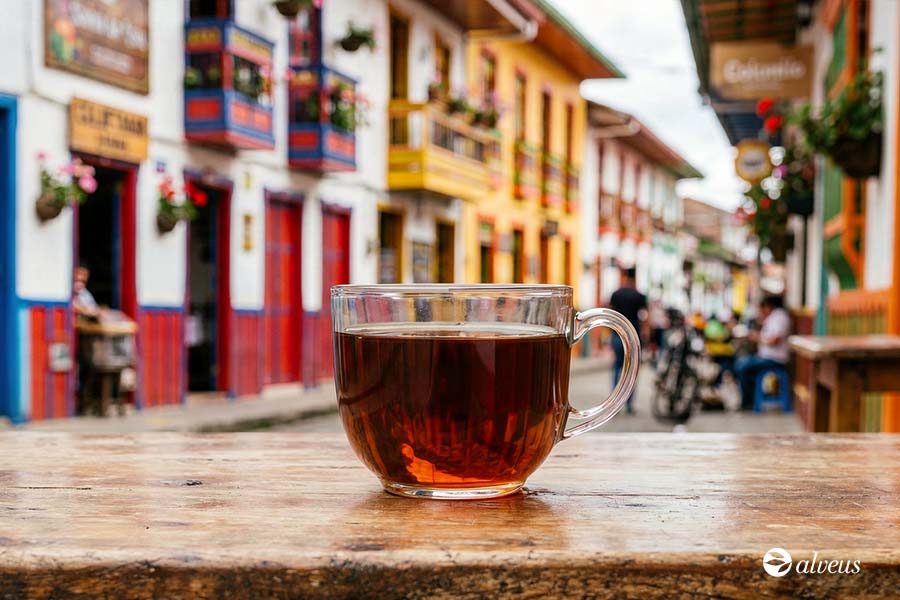
When we talk about Colombia, the mind almost automatically drifts to coffee, green mountains, ripe fruit, colourful markets and that tropical intensity that seems to permeate everything. That is why discovering a Colombian black tea feels almost like a small revelation. It is not the origin the consumer expects, and that is where much of its commercial appeal lies.
This tea offers pure value for a European tea shop or brand seeking to differentiate its range from the competition. Our Colombian black tea doesn’t compete solely on price or intensity; it competes on its story, its origin and a sensory profile familiar to those who know classic black teas from India, Sri Lanka or China, but are looking for a different origin.
Key facts about Alveus’s organic Colombian black tea
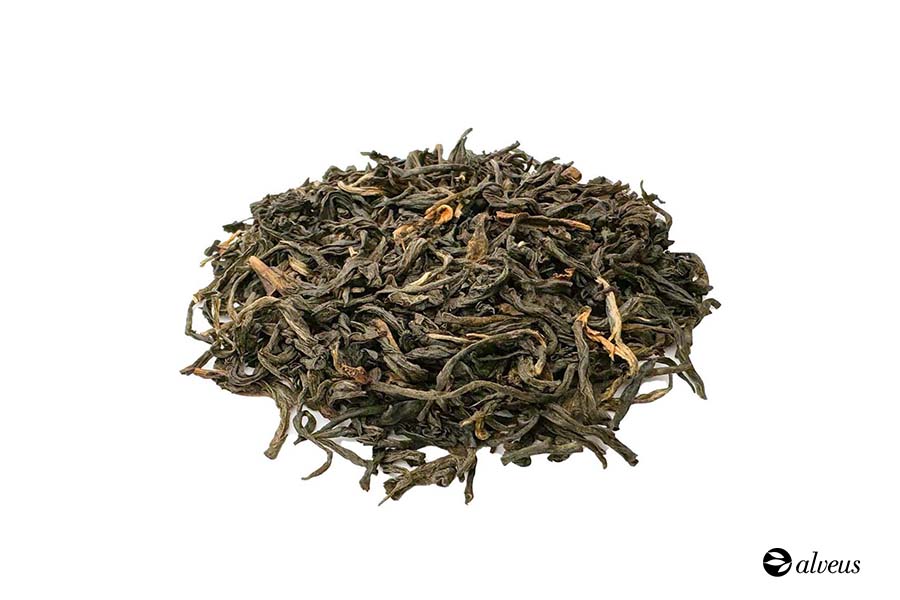
Organic Colombian black tea. Alveus reference 80007
- Tea type: Organic loose-leaf black tea
- Origin: Colombia, Western Andes
- Growing region: Near Bitaco, in the west of the Valle del Cauca department.
- Altitude: Between 1,800 and 2,000 metres above sea level.
- Harvest: Hand-picked
- Leaves: Medium to large black leaves, with some golden tips.
- Cup profile: Slightly sweet, intense and full-bodied.
- Main notes: Sugar cane, cocoa, and a hint of chocolate.
- Standard preparation: 12–15 g per litre, water at 100 °C and 5 minutes’ infusion.
- Best enjoyed: Breakfast, mid-morning, after lunch or as an afternoon snack.
- Can it be drunk with milk?: Yes
- Pairing: Sponge cakes, cocoa-based pastries, roasted nuts, bread and butter, oatmeal biscuits and semi-mature cheeses
The Andean landscape that shapes this tea
The plantation is located near the small village of Bitaco, in the west of the Valle del Cauca department, in the western Colombian Andes. It is a mountainous area where the tea grows at an altitude of approximately 1,800 to 2,000 metres above sea level, a very favourable altitude for producing a tea with a delicate, aromatic and mellow profile.
Altitude is not merely a technical detail. In tea, as in wine or coffee, the growing environment influences the leaf’s final expression. Temperature, humidity, soil, sun exposure, mist, rain and surrounding vegetation all form part of what we call terroir.
In high-altitude areas, the plant tends to grow at a different pace, and this slowness can promote greater aromatic concentration and a more elegant structure in the cup. Here, the landscape serves not only as an emotional element. It also helps explain why this black tea has a sweet, intense and full-bodied profile, whilst maintaining a balanced and pleasant sensation on the palate.
The mountains bring freshness; the humid climate favours plant growth; the mineral-rich soil contributes to the crop’s identity; and the proximity between the garden and the factory allows the freshly harvested leaves to be processed quickly.
Biodiversity and the mountains: the value of the region
One of the most appealing aspects of this origin is the natural environment. The Bitaco Forest Reserve is situated in the upper reaches of the Bitaco River sub-basin, a tributary of the Dagua River, within the municipality of La Cumbre.
This means that for the end consumer, it is not just any tea, but a leaf that grows in a living, humid, green, protected and diverse landscape. For the professional, this provenance allows for a richer sales pitch, where the flavour is accompanied by the origin, the Andean mountains, biodiversity and a unique growing environment.
Hand-picked and processed close to the garden
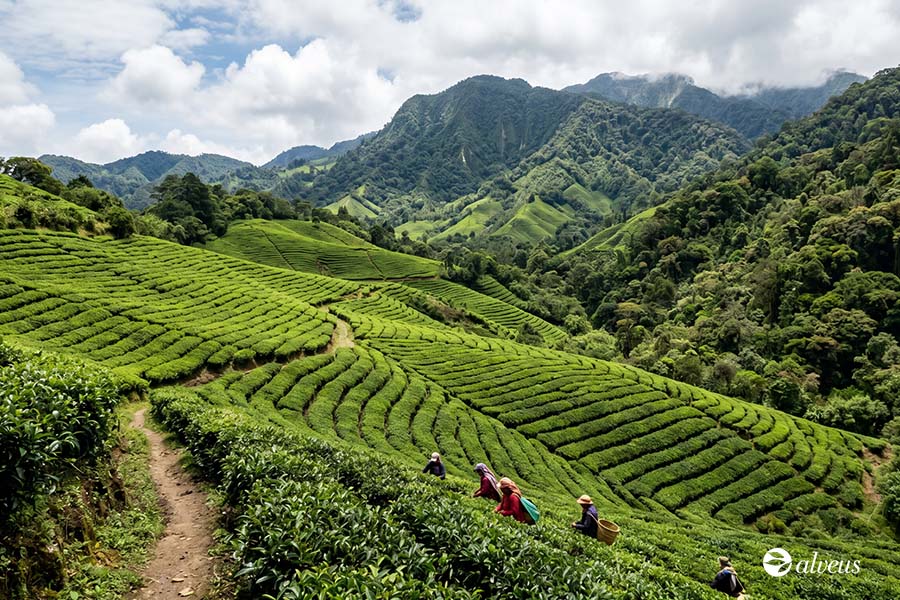
In Bitaco, they work with loose-leaf teas produced using orthodox methods, an approach that seeks to better preserve the structure of the leaf and more clearly express the character of the origin. In this area, tea is produced all year round, and black tea occupies a particularly significant place in its production.
This approach helps to explain the quality perceived in the cup and also in the appearance of the leaf. In an orthodox black tea, the leaf usually remains more recognisable than in CTC processes, where it is cut, broken and rolled to produce small particles designed for a quick and intense infusion. In contrast, the orthodox leaf allows the product to be better appreciated at a glance, with medium to large black leaves, a more refined shape and the presence of some golden tips.
For any tea shop or brand, this difference matters. A visually appealing leaf helps with bulk sales, samples, product photography and commercial presentations. The golden tips, moreover, suggest a harvest with tender buds and lend an aspirational quality to the product.
Tasting profile of our Colombian black tea
When dry, the leaf is black in appearance, medium to large in size, with some golden tips. Visually, it conveys quality, naturalness and presence.
In the cup, the first feature worth highlighting is its sweet notes reminiscent of sugarcane, light molasses or mild panela. There are also hints of cocoa, which lend a deeper dimension, almost like smooth dark chocolate, which may prove very appealing to coffee drinkers looking to switch to tea. Its body is rounded, capable of filling the mouth without feeling heavy.
The intensity is well balanced, sufficient for those expecting character in a black tea, yet with a gentle profile that allows it to be enjoyed on its own. This makes it a versatile choice. It works well as a morning tea, a mid-afternoon tea, an alternative to coffee, or as the foundation for a range of single-origin teas with distinct character.
Recommended preparation and pairing
For a balanced brew, use water at 90–95 °C, approximately 2–3 grams per 200 ml, and steep for 3 to 4 minutes. If you’re looking for a sweeter, rounder cup, start with 3 minutes. If you want more body and intensity, extend the steeping time to 4 minutes.
It is advisable to try it first on its own, without milk or sugar, to appreciate the notes of sugarcane and cocoa. Even so, given its body, it can accommodate a splash of milk if the customer so wishes, particularly in the hospitality sector. Served cold, brewed with slightly more leaves and then chilled, it offers less astringency, revealing its natural sweetness and a softer cocoa undertone.
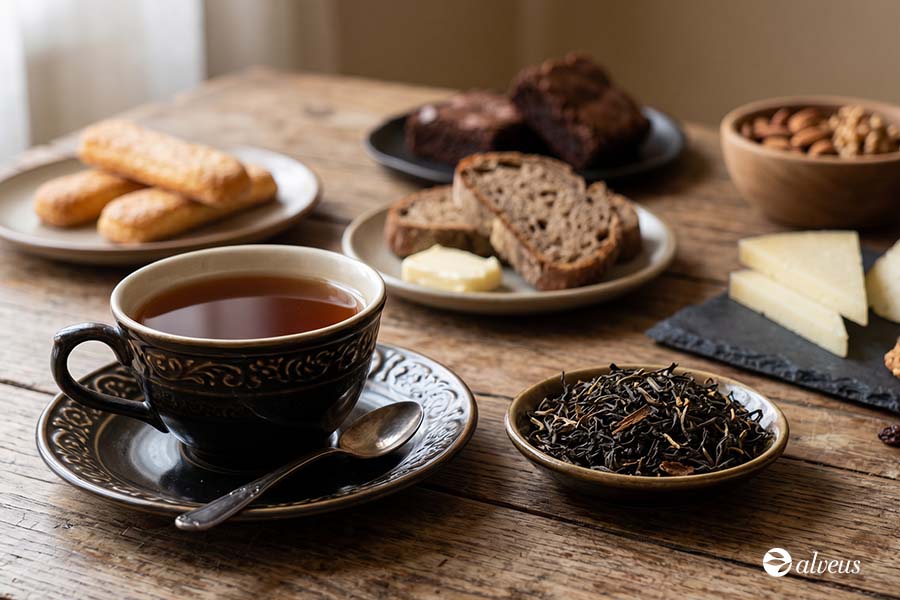
It pairs well with simple sponge cakes, sourdough bread with butter, cocoa-based pastries, oatmeal biscuits, roasted nuts and semi-matured cheeses. It can also accompany hotel breakfasts or brunch menus where a drink with presence is sought, but one that is lighter than coffee.
This standard preparation is designed to yield a full, intense cup with all the body expected of a good black tea. As it is a medium to large-sized leaf and a fully oxidised tea, freshly boiled water promotes a generous extraction, bringing out its colour, structure and sweet notes of sugar cane and cocoa.
It is an ideal brew for those seeking a tea with character, whether enjoyed on its own or with breakfast, afternoon tea or even served with a dash of milk.
Why add it to your range
Most businesses offer black teas from origins such as China, India, or Africa. However, very few include a source as rare and original as Colombia. In the speciality tea market, origin has become a decisive factor for a more informed, curious consumer who is open to new experiences.
Furthermore, this tea brings together all the elements to craft a story of genuine value. It is born in a mountainous landscape, its leaves are carefully processed using orthodox methods, and in the cup it offers a sweet, full-bodied profile with notes of cocoa that are highly appealing. That is why few teas allow for such natural and evocative storytelling to connect with your customers from the source to the cup.
Another advantage of incorporating this tea into your business is that it works very well in a ‘black teas of the world’ pack alongside the classics from China, Sri Lanka, India, Nepal… In this context, Colombia stands out because it breaks the expected mould.
How to present and sell it in-store
The word ‘Colombia’ already sparks curiosity, but it shouldn’t be the only selling point. The pitch gains strength when structured in three layers.
First, the origin: a black tea grown in the western Andes, near Bitaco, in a high-altitude area rich in biodiversity.
Second, the visual and technical quality: loose-leaf, hand-picked, locally processed and with golden tips.
Third, the sensory experience: sweet, intense, full-bodied, with notes of sugar cane and cocoa.
This structure helps the salesperson avoid resorting to a generic phrase such as ‘it’s a rare tea’. Better to say:
A brief, clear and sensory explanation that helps turn the origin into a desire and the tasting into a selling point.