

To speak of British tea is, to a large extent, to speak of black tea blends. Although the United Kingdom is not a tea-producing country, its influence on the way black tea is blended, prepared and consumed has been enormous.
For centuries, maritime trade linked British ports with tea-producing regions such as India, Sri Lanka, China and East Africa. From this exchange emerged a tea culture deeply rooted in blending, combining different origins and adjusting the body, strength, aroma, and colour in the cup until a recognisable and consistent profile was achieved.
This helps us understand why British blends continue to carry so much weight in specialist shops. They are not merely classic names. They are tailored to very specific moments of consumption: the strong morning tea, the cup with milk at breakfast, the mid-afternoon Earl Grey, the lighter blend to accompany pastries, or the intense blend that customers associate with comfort, routine and familiarity.
As a tea shop owner, this information will help you explain the product more effectively, make more precise recommendations, and convey to customers why an English Breakfast should not convey the same impression as an Irish Breakfast. Or why an Earl Grey can have very different nuances depending on the base tea used.
Below, we review the most popular British blends, their origins, their sensory profiles and the role they can play in a tea shop.
The breakfast tea family
Breakfast teas represent the most everyday expression of British blending. They are blends of black tea with sufficient body, vibrancy, and intensity to retain their character even when milk or sugar is added.
Although today they are mainly associated with breakfast, many British and Irish consumers drink them throughout the day. For a specialist tea shop, they are fast-moving stock items and a gateway to loose-leaf tea for those looking to swap the conventional tea bag for a higher-quality cup of tea.
English Breakfast
English Breakfast is one of the world’s best-known black tea blends, but its origin cannot be attributed with absolute certainty to a single person or recipe. Before India and Sri Lanka became major producing regions, the teas consumed in Great Britain came from China. Consequently, the earliest teas intended for breakfast would have had a unique character from that of today’s blends.
With the development of the Assam plantations during the 19th century and, later, of Ceylon production, the composition evolved. Today, English Breakfast typically blends black teas from Assam, Sri Lanka and, in some versions, East Africa. There are also variations based on Keemun or other Chinese teas. There is no single recipe, but rather a shared expectation of offering a robust, balanced and pleasant cup when served with milk.
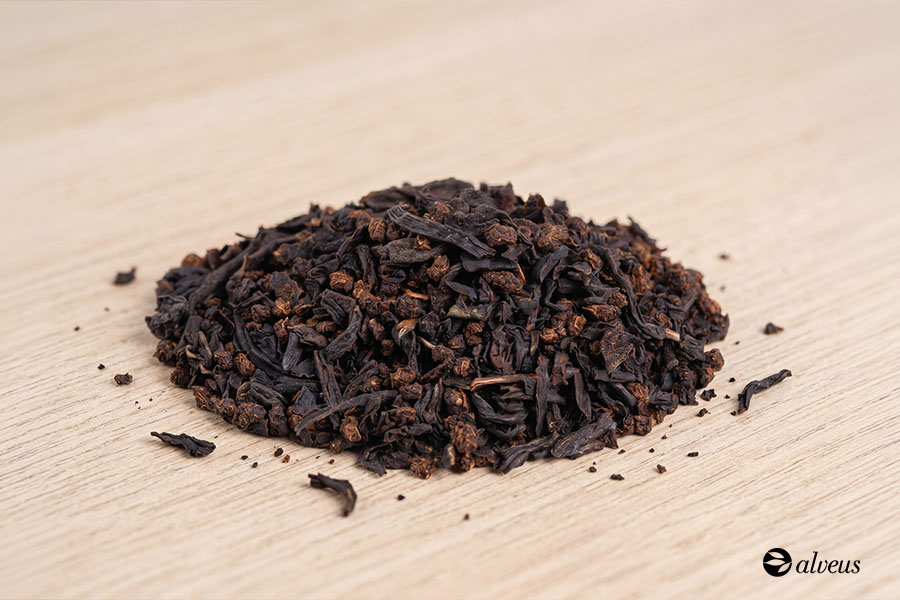
Alveus English Breakfast Broken, reference 82420
Our blend, in our organic English Breakfast Broken, combines Assam and Ceylon, two particularly complementary origins. Assam provides a full-bodied, malty and warm base, whilst Ceylon adds vibrancy, a cleaner astringency and a slightly fresh finish. The result is a black tea with character, yet less robust than an Assam-dominated Irish Breakfast.
This versatility accounts for much of its success. It can be enjoyed on its own, with milk or lightly sweetened; it works well at breakfast, but also as an everyday black tea. In-store, it is easy to recommend to customers asking for ‘a classic tea’, although that apparent simplicity should not prevent us from explaining the quality of the leaves, the origin of the components or the careful balancing achieved in the blend.
Irish Breakfast
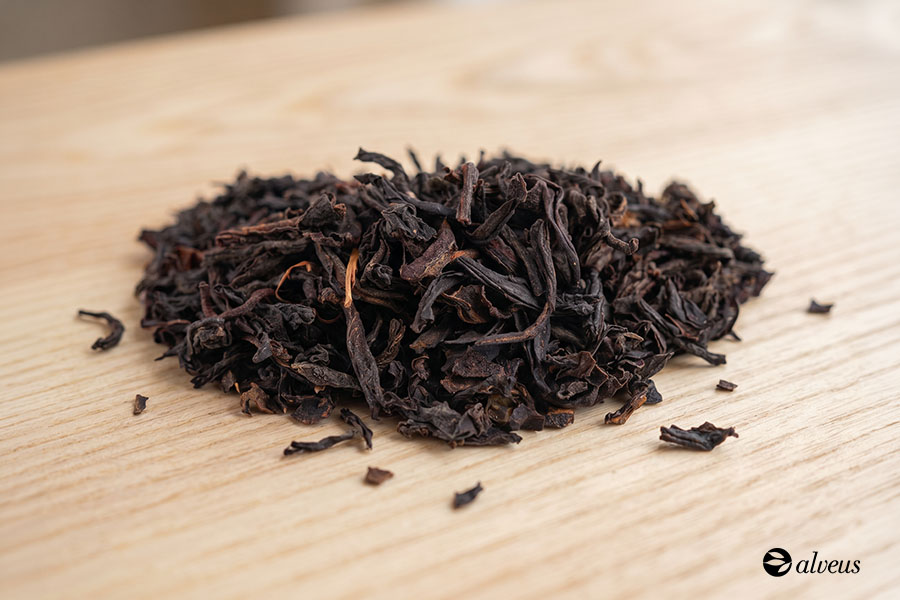
Alveus Irish Breakfast, reference 81544
Irish Breakfast belongs to the same family, but usually contains a higher proportion of Assam or other black teas capable of imparting strength, colour, and body. Its liquor is generally darker and its profile more malty, intense and astringent than that of an English Breakfast.
Nor is there an official formula. Some blends combine Assam and Ceylon; others incorporate teas from Kenya or Rwanda to enhance the colour and vibrancy. There are even versions marketed as being made solely from Assam when their profile meets consumer expectations for this style.
Leaf size also plays a part. Broken grades and CTC-processed teas quickly release colour, caffeine, tannins and flavour, resulting in a robust infusion that can accommodate a generous amount of milk. An orthodox-leaf version can retain the style’s robust character whilst offering greater aromatic complexity and a smoother texture.
Despite its name, in Ireland, this type of tea is not limited to breakfast. The term ‘Irish Breakfast’ is used mainly outside the country to describe the Irish preference for a strong, dark cup of tea, often served with milk.
When a customer is torn between English and Irish Breakfast, the most useful question to ask is how much body they are looking for. English Breakfast offers greater balance; Irish Breakfast is better suited to those seeking strength, maltiness and a distinct presence even with milk.
Scottish Breakfast
Scottish Breakfast is typically described as the most intense of the three major breakfast blends. It typically combines full-bodied black teas, frequently Assam and African teas, to produce a dark, vigorous and distinctly astringent brew.
There is a widely repeated story that it was created to produce a strong brew even with Scotland’s soft water. However, it is more accurate to view it as a commercial and sensory evolution of the breakfast tea family rather than as a recipe dictated by the chemistry of the water.
Earl Grey, the great bergamot classic
Few aromas are recognised as instantly as that of Earl Grey. Its identity stems from the combination of tea and bergamot, a citrus fruit grown mainly in Calabria, whose essential oil has a fresh, floral and slightly bitter scent.
Tradition links the blend to Charles Grey, British Prime Minister between 1830 and 1834. Some tea houses claim to have created the blend for him, but the available documentation does not allow us to confirm a single version of events. There are references to tea flavoured with bergamot predating the establishment of the name ‘Earl Grey’, so it is best to regard the story as a tradition rather than an indisputable fact.
More important than unravelling its legend is understanding why the combination has endured. Bergamot brings brightness to black tea, enhances its nuances and leaves a very distinct aromatic impression. At the same time, the tea base influences the way the citrus flavour expresses itself. A light base results in a delicate and fragrant Earl Grey, whilst a more intense base creates a cup with greater body and contrast.
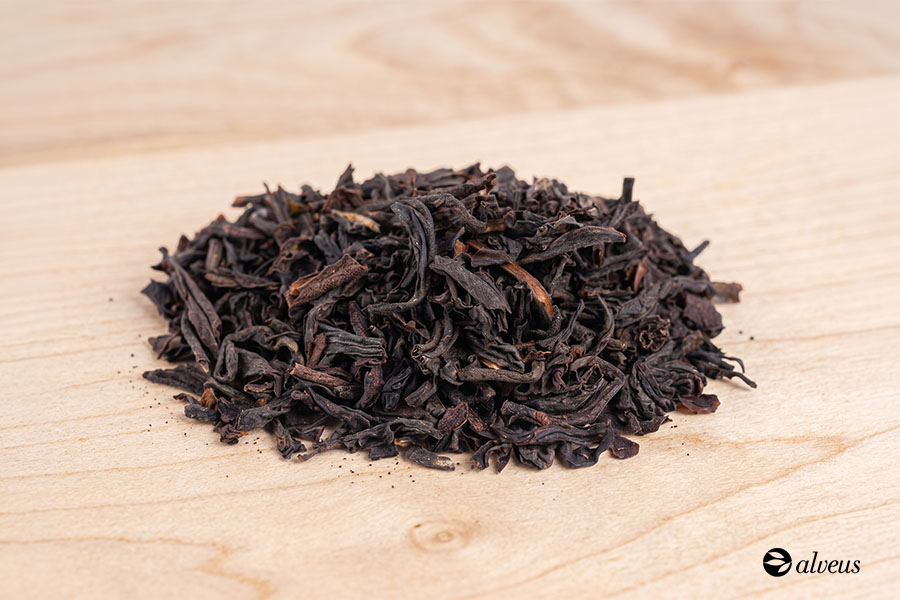
Alveus Organic Earl Grey, reference 84063.
Our Organic Earl Grey combines black tea from Assam and southern India with natural bergamot flavouring. The Assam provides structure, depth and malty notes, whilst the tea from southern India helps to round out the blend and promotes a balanced aromatic profile. The bergamot completes the blend with its characteristic citrus freshness.
To properly assess an Earl Grey, it is not enough simply to check the intensity of its dry aroma. In the cup, there must be continuity between fragrance and flavour, and the bergamot should not completely mask the tea’s identity. An overly dominant aroma may make a strong initial impression, but can become flat or tiresome when drunk frequently.
It is also important to note that ‘Earl Grey’ does not refer to a specific type of tea or a geographical origin. It is a flavoured tea and can be made using black, green, white or oolong bases, although the classic version uses black tea. Numerous variations have emerged from this, featuring flowers, citrus peel, vanilla or smokier profiles.
Afternoon Tea
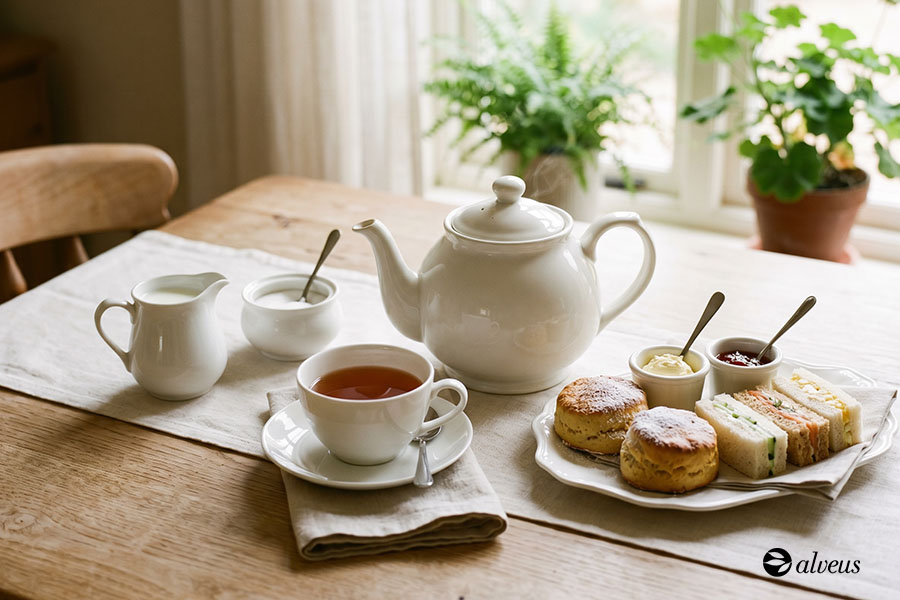
The tradition of afternoon tea led to the development of blends that are less robust than those intended for breakfast. There is no universal recipe for what is known as ‘Afternoon Tea’ or ‘Afternoon Blend’, but the aim is usually to create a milder, more aromatic infusion that pairs well with sandwiches, scones, or pastries.
Russian Caravan
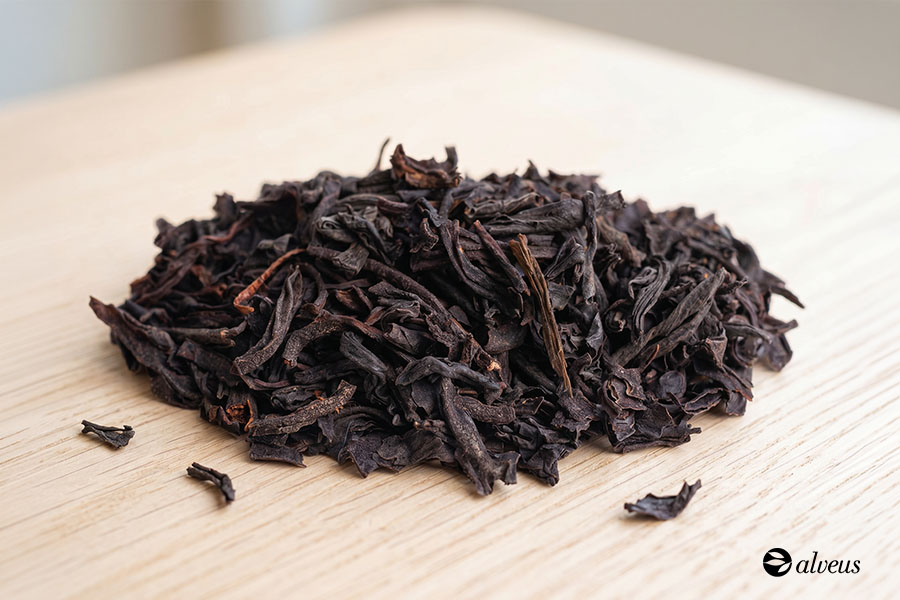
Russian Caravan BIO by Alveus, reference 84422
Russian Caravan did not originate as a British national blend, but it occupies a significant place in the history of blends consumed and marketed in Europe. Its name evokes the caravans that transported tea from China to Russia via long overland routes.
It is traditionally associated with Chinese black teas such as Keemun, with toasty, woody or slightly smoky notes. Some versions incorporate Lapsang Souchong to intensify that smoky character, although not all historical blends necessarily possessed the smoky character that is now considered typical.