

Green tea is one of the largest families of tea, whilst also being one of the most diverse and complex.
Within the same category, we find teas with tasting notes as varied as the sweet, toasty flavour of Chinese Lung Ching or the intense vegetal and umami character of Japanese Gyokuro.
They all come from the Camellia sinensis plant, but the origin, cultivar, harvest, shading and, above all, the method used to stop the oxidation of the leaves determine very different styles.
Here are some of the most frequently asked questions to help you better understand what green tea is and how to enjoy it.
What is green tea and which plant does it come from?
Green tea is a type of tea made from the leaves and buds of Camellia sinensis, the same plant species from which white, yellow, oolong, black and dark teas are derived.
What turns these leaves into green tea is not a specific plant variety, but rather the processing method. Shortly after harvesting, heat is applied to deactivate the enzymes responsible for oxidation. This step, known as fixation, preserves much of the fresh leaf’s botanical characteristics and a high proportion of its original catechins.
Due to the terroir and production processes, there is therefore no single ‘green tea flavour’. The cultivar, the location where the plant grows, the harvest season, the selection of the leaves and the manufacturing technique can all result in radically different teas.
What does green tea taste like?
It depends very much on its origin and how it has been produced.
Green teas can exhibit aromas and flavours reminiscent of:
- Freshly cut grass.
- Spinach.
- Asparagus.
- Artichoke.
- Green beans.
- Seaweed and sea breeze.
- Chestnut.
- Almond.
- Hazelnut.
- Cereals.
- White flowers.
- Citrus fruits.
- Fruit.
- Butter.
- Vegetable stock.
- Sweetcorn.
Chinese green teas processed using dry heat tend to develop sweet, floral, cooked vegetable and nutty notes more readily.
In many steamed Japanese teas, green vegetables, seaweed, fresh grass and umami flavours predominate.
This last flavour is particularly important in Gyokuro, Kabusecha and some high-quality Sencha and Matcha.
A good green tea does not necessarily always have to be extremely mild. It may exhibit bitterness and astringency, but these should form part of a balanced profile.
How is green tea produced?
Although there are hundreds of methods and styles, the production of green tea can be summarised in four main stages:
Harvest. Leaves and buds are picked, usually whilst they are still young and tender.
Wilting. This is not always a lengthy stage. In many green teas, the leaf begins to lose moisture simply during the time between harvesting and arrival at the factory. Some producers carry out deliberate wilting to alter the aroma and facilitate subsequent shaping.
Fixation. This is the most crucial stage in production. It involves applying heat to rapidly deactivate enzymes such as polyphenol oxidase, with the aim of halting enzymatic oxidation.
Rolling. The leaves may be rolled, flattened, curled or shaped in other ways depending on the style. Lung Ching, for example, has flattened leaves, whilst Sencha develops its characteristic appearance of fine needles.
Drying. Finally, any remaining moisture is removed to stabilise the tea and enable its preservation.
The main difference lies in the fixation process. In China, it is traditional to use hot surfaces (woks, frying pans or drums), whilst in Japan, steam fixation is the predominant method. Whether one method or the other is used will significantly affect the flavour of the green tea.
What is the difference between green tea and white tea?
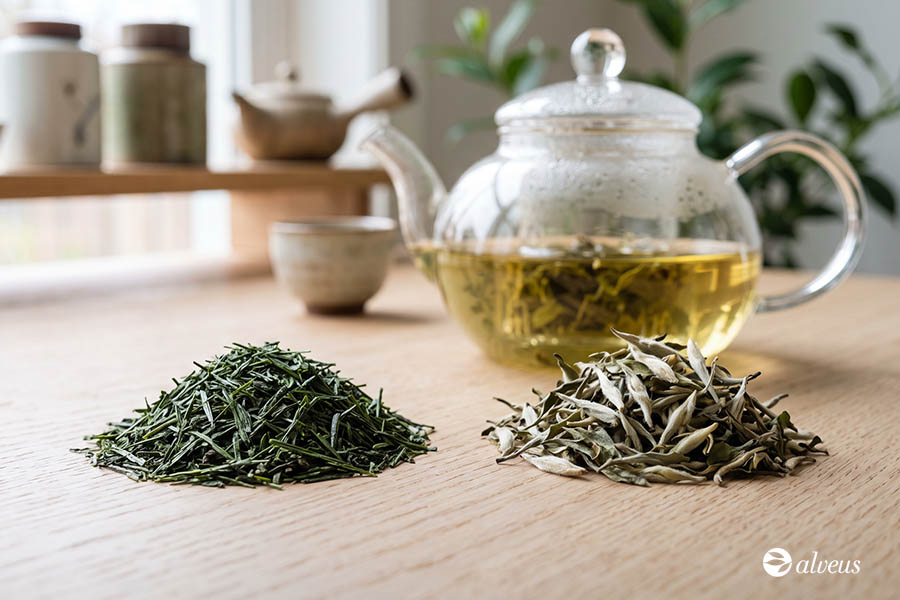
Both come from Camellia sinensis, but are processed differently.
Green tea is deliberately subjected to heat fixation shortly after harvesting to halt enzymatic oxidation. It is then usually rolled or shaped and finally dried.
White tea traditionally involves a much simpler production process. To produce it, the leaves or buds are withered and dried without a specific fixation stage immediately after harvesting. During this process, a small amount of natural, slow oxidation may occur.
There is also often a sensory difference. White teas tend to offer more delicate, floral, honeyed and mellow profiles, whilst green teas may exhibit vegetal, herbaceous, marine, toasty, nutty or intensely umami notes.
However, the fundamental difference does not lie in one having white leaves and the other green ones, but in how those leaves are processed.
Why doesn’t green tea oxidise like black tea?
In reality, to say that green tea ‘does not oxidise’ is an oversimplification.
From the moment a tea leaf is harvested, changes begin to take place. The difference is that, during the production of green tea, enzymatic oxidation is halted very early on.
Heat is applied during the fixation stage to achieve this. This deactivates the enzymes that catalyse the oxidation of the leaf’s polyphenols.
With black tea, practically the opposite happens, as the leaves are withered and rolled or macerated to encourage contact between their internal components and oxygen, allowing for much more extensive oxidation before drying.
This is why a large proportion of the original catechins remain in green tea, whilst in black tea a significant amount is transformed into other compounds, including theaflavins and thearubigins.
This fixation also explains why green teas often retain aromas that are more clearly reminiscent of fresh vegetation.
What are the main types of green tea?
The variety is wide, and there is no single, universally accepted classification. A practical way to understand it is to distinguish between the major Chinese and Japanese styles.
Tés verdes chinos
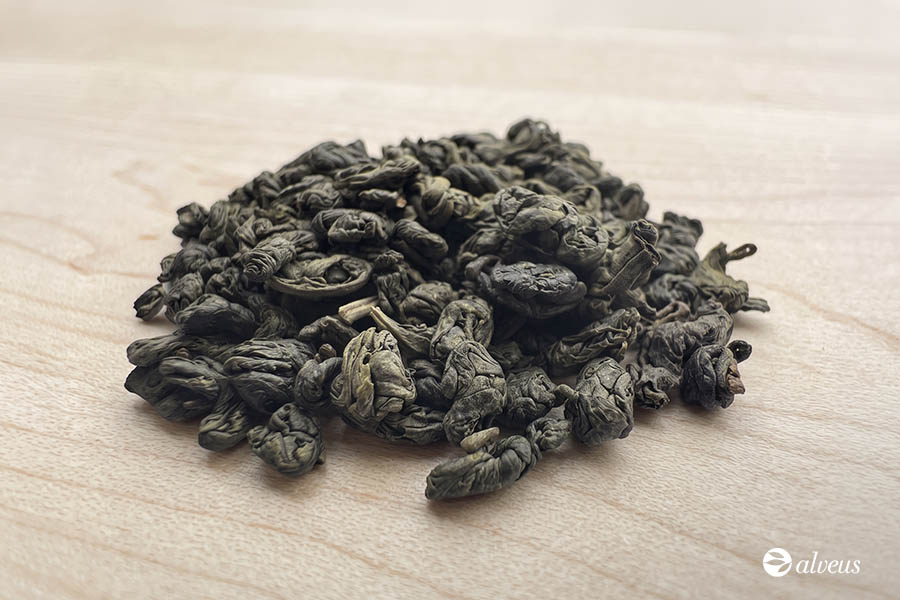
Alveus Organic Premium Gunpowder Green Tea, product code 82183
China has hundreds of regional varieties. Among the most important are:
- Long Jing or Dragon Well, from Zhejiang.
- Bi Luo Chun, traditionally associated with Jiangsu.
- Huang Shan Mao Feng, from Anhui.
- Liu An Gua Pian, also from Anhui.
- Tai Ping Hou Kui, from Anhui.
- Xin Yang Mao Jian, from Henan.
- Gunpowder, produced in the form of small pellets.
- Chun Mee, with curved leaves resembling an eyebrow.
Japanese green teas
Japan classifies many of its teas according to how they are grown and processed:
- Sencha, the most representative Japanese style.
- Gyokuro, grown in the shade before harvesting.
- Kabusecha, also shaded, usually for a shorter period than Gyokuro.
- Bancha, generally made from more mature leaves.
- Genmaicha, green tea mixed with roasted rice.
- Hojicha, green tea that is subsequently roasted.
- Tamaryokucha, with curled leaves.
- Matcha, a powdered green tea made from Tencha.
Furthermore, countries such as South Korea, Vietnam, India, Indonesia, Nepal and Sri Lanka produce their own styles of green tea.
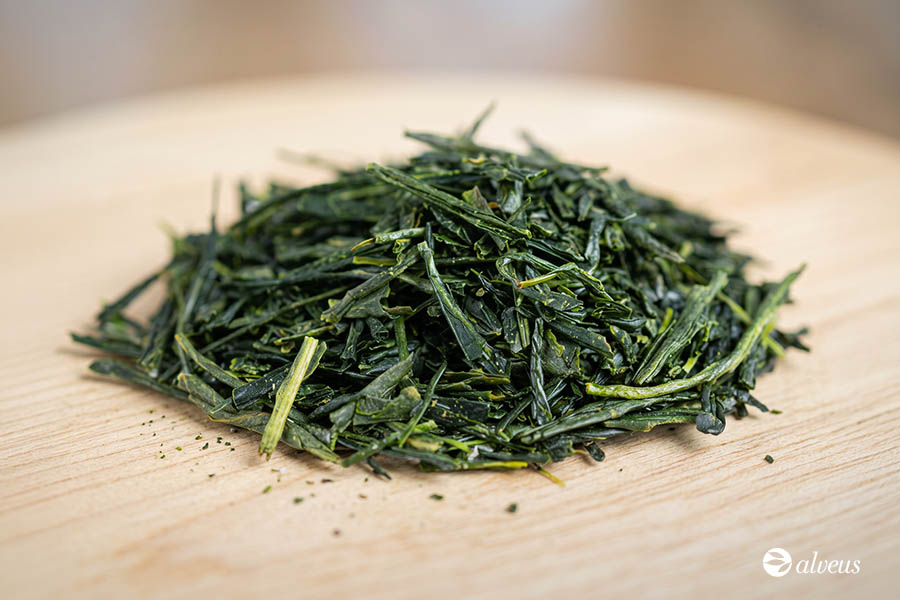
Organic Gyokuro Mikoto green tea, Alveus product code 82925
What are the differences between Chinese and Japanese green tea?
One of the most significant differences lies in the processing of the leaves.
Chinese green tea
In China, the use of dry heat—via a wok, frying pan or hot drum—is traditionally the predominant method.
This treatment tends to produce profiles with notes of:
- Chestnuts and other nuts.
- Cooked vegetables.
- Flowers.
- Fresh wood.
- Pulses.
- Cereals.
- Mild toasty notes.
- Sweetness.
A high-quality Long Jing may be reminiscent of chestnuts, green beans, asparagus and toasted nuts.
Japanese green tea
In Japan, steam fixation is the predominant method. The leaves are exposed to steam for a very short time before undergoing successive stages of rolling and drying.
Common sensory characteristics include:
- Fresh grass.
- Spinach.
- Seaweed.
- Green vegetables.
- Marine notes.
- Umami.
- Vegetable sweetness.
The duration of steaming is also important. In Sencha, we find styles such as asamushi, which is lightly steamed, and fukamushi, which undergoes a more thorough treatment that breaks down the leaf structure more, and often produces denser, cloudier infusions.
This does not mean that all Chinese green teas are mild, nor that all Japanese ones are intensely sea-like. These are general trends within two extraordinarily diverse production traditions.
Which are the most important green tea-producing countries?
China is, by far, the world’s leading producer of green tea, both in terms of volume and diversity. It is also the world’s largest tea producer. According to data from the International Tea Committee compiled by the Tea Board of India, its total production reached some 3,740 million kilograms in 2024.
Japan occupies a different position, as its total volume is much lower, at around 74,000 tonnes of aracha or raw tea in 2024. However, its industry is highly specialised in green tea and has developed its own styles such as Sencha, Gyokuro and Matcha.
Vietnam and Indonesia are also long-standing producers of significant quantities of green tea. The FAO has ranked them, alongside China and Japan, amongst the leading producing countries in this category.
There is also significant or growing production in India, South Korea, Nepal, Sri Lanka and other countries.
Volume, however, should not be confused with quality. Some of the most interesting green teas on the market come from very small, localised productions.
Which are the most popular green teas?
There is no global ranking that allows us to rigorously determine which are ‘the most popular’, as consumption varies greatly from country to country. However, some styles have achieved particularly widespread international recognition.
Sencha. This is Japan’s most widely consumed everyday green tea and one of its most representative styles.
Matcha. Its traditional use in chanoyu coexists today with a huge international market for drinks, pastry, and gastronomy.
Long Jing or Dragon Well. One of the most famous Chinese green teas. It is recognised by its flattened leaves and its vegetal, sweet and slightly toasty flavour profile.
Gunpowder. Its leaves are rolled into small pellets. It is one of the most widely consumed Chinese green teas internationally and traditionally forms one of the bases of North African mint tea.
Gyokuro. One of the great Japanese shaded green teas, known for its pronounced umami and dense texture.
Genmaicha. A Japanese green tea blended with toasted rice, which imparts cereal and toasty aromas.
Jasmine green tea. Rather than a variety of green tea, this is a green tea traditionally scented with jasmine flowers. It has become one of the world’s best-known flavoured teas.
Bi Luo Chun. One of China’s great traditional green teas, prized for its delicately rolled leaves and fragrant character.
Is Matcha a green tea?
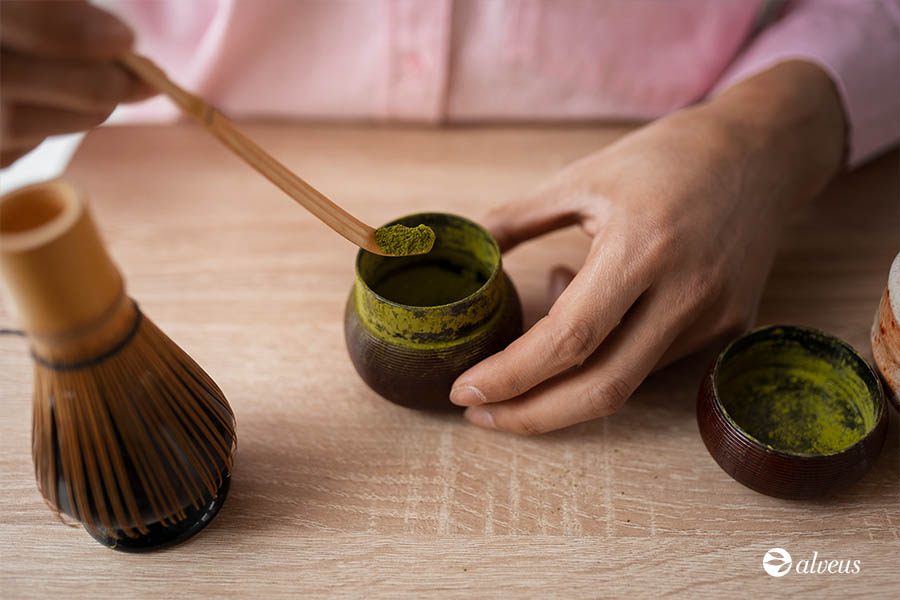
Yes. Authentic Matcha is a powdered Japanese green tea made from Tencha.
The plants grown to produce Tencha are cultivated in the shade prior to harvest. This change in light exposure alters the composition of the leaves and promotes a higher concentration of certain amino acids associated with the umami flavour.
After harvesting, the leaves are steamed and processed without the rolling typical of Sencha. The stems and veins are then removed, yielding Tencha, which is finally ground into an extremely fine powder.
The way it is consumed also differs. In a conventional infusion, the leaves are removed; when we drink Matcha, we ingest the particles of the leaf itself suspended in water.
Why are some green teas bitter or astringent?
Because bitterness and astringency are natural components of tea, although poor preparation can intensify them to the point of becoming unpleasant.
They are not exactly the same.
Bitterness is a flavour which is related, amongst other components, to caffeine and certain catechins.
Astringency is a tactile sensation that produces a feeling of dryness or tightness when certain polyphenols interact with proteins in saliva.
Young leaves may contain significant concentrations of these components. However, other compounds, particularly amino acids such as L-theanine, contribute sweetness and umami and help to create balance in the cup.
A green tea may taste excessively bitter for four main reasons:
- Water that is too hot.
- Infusion time too long.
- Too many leaves.
- Low-quality or poorly stored tea.
How do you brew green tea correctly?
There is no universal temperature or brewing time for green tea, as each style may require different parameters.
As a general guide, delicate Chinese green teas are usually brewed with lukewarm water, around 75–80 °C, whilst Japanese teas such as Sencha tend to be brewed at slightly lower temperatures.
Gyokuro requires a particularly gentle brewing method, using cooler water and a higher proportion of leaves, to bring out its texture and umami flavour.
In contrast, varieties such as Bancha or Genmaicha tolerate slightly higher temperatures.
These guidelines are merely a starting point. The amount of tea, the volume of water, the size of the vessel and the desired flavour profile also influence the result. If the infusion is too bitter or astringent, it is advisable to reduce the temperature or shorten the steeping time; if it is too light, the amount of leaves can be increased slightly or the steeping time extended.
What sort of water should you use to make green tea?
It is best to use fresh, good-tasting water with low or moderate mineral content. Excessively hard water can reduce the tea’s aromatic clarity and alter its texture.
Why shouldn’t you use boiling water for green tea?
A high temperature accelerates extraction. In a delicate tea, this can release caffeine, catechins and other components associated with bitterness and astringency too quickly.
This does not mean that the hot water literally ‘burns’ the leaf. The problem is mainly the extraction: we end up with a different proportion of components, which is often less balanced.
Temperature can therefore be used as a genuine tasting tool.
Can green tea be steeped several times?
Yes. In fact, many good-quality green teas are designed to yield several infusions.
It is particularly interesting to do so with high-quality Senchas, Gyokuros, Long Jing, Bi Luo Chun or Kabusechas, amongst others.
Subsequent infusions do not exactly replicate the first cup. The proportion of substances that leach into the water changes, and with it, the sensory profile.
In the Japanese method, for example, the second infusion of a Sencha can be very brief because the leaves are already hydrated and unfurled. In some cases, just a few seconds are enough.
Can green tea be brewed with cold water?
Yes. Cold brewing can work well with green tea.
The low temperature alters the speed and proportion at which the various components of the leaves are released into the water. The result is usually a drink with:
- Less bitterness.
- Less pronounced astringency.
- A greater perception of sweetness.
- A fresh aromatic profile.
A simple method is to use approximately 8–12 grams of tea per litre of cold water and leave it in the fridge for 6 to 10 hours, then strain it.
Another, more concentrated option for Sencha or Gyokuro involves using a large quantity of leaves with very little cold water or even ice, and allowing for a much slower extraction.
How much caffeine is there in green tea? Does it contain less than black tea?
Not necessarily. The caffeine content of green tea can be equal to or even higher than that of some black teas. Analyses of various commercial teas have found widely varying levels, ranging from approximately 14 to 61 mg per serving, with no clear correlation between the colour of the tea and its caffeine content.
The concentration depends on the cultivar, the age of the leaves, the presence of buds, shading, the quantity used, the particle size, the water temperature and the steeping time. Japanese teas grown in the shade, such as Gyokuro and Matcha, can contain quite a lot of caffeine; in the case of Matcha, moreover, the powdered leaf is consumed. Therefore, the caffeine content depends on the specific tea and how it is prepared.
What are the properties and benefits of green tea?
Green tea contains caffeine, L-theanine and numerous polyphenols, notably catechins and, in particular, EGCG. These compounds have attracted interest due to their possible link to various aspects of health, although their effects depend on factors such as dosage, frequency of consumption, individual characteristics and the way it is consumed. Drinking an infusion is not the same as consuming a concentrated extract.
Some research suggests possible modest effects on certain cardiovascular markers. For example, a systematic review and meta-analysis of 55 clinical trials observed small improvements in total cholesterol, LDL cholesterol, glucose and diastolic blood pressure following green tea supplementation (‘Green tea supplementation and cardiometabolic risk factors’). Furthermore, some observational studies have linked low or moderate consumption of green tea with a reduced risk of coronary heart disease and stroke, although these associations do not in themselves prove that tea is the cause of this effect (Green tea consumption and coronary heart disease risk; Green tea consumption and stroke risk). Therefore, although catechins exhibit antioxidant activity in laboratory studies, it is not appropriate to translate this directly into claims such as that green tea ‘eliminates free radicals’ from the body.
Green tea is also known for its potential to aid weight loss, but there is no solid evidence to present green tea as a slimming product either. A Cochrane review concluded that green tea preparations had a small effect on weight loss, which was probably of no clinical significance (Green tea for weight loss and weight maintenance).
Regular consumption of green tea can form part of a healthy diet, particularly if it replaces sugary drinks, but it is no substitute for a balanced diet or physical activity.
What are the contraindications of green tea?
For most healthy adults, green tea consumed as an infusion and in moderate amounts is a safe drink. However, it contains caffeine, which can cause insomnia, nervousness, palpitations or digestive discomfort in sensitive individuals. The EFSA considers that up to 400 mg of caffeine per day is safe for most adults, although it is advisable to avoid consuming it close to bedtime.
The polyphenols in tea can reduce the absorption of non-haem iron, particularly that from plant-based foods. Therefore, people with iron-deficiency anaemia or low iron levels should avoid drinking tea with main meals or whilst taking iron supplements. During pregnancy, it is also important to monitor total daily caffeine intake, which ACOG recommends keeping below 200 mg.
Green tea, and particularly its concentrated extracts, can interact with certain medicines. It has been observed, for example, that it can reduce the concentration of nadolol in the blood and alter its effect. Anyone undergoing long-term treatment should consult a doctor or pharmacist before consuming large quantities of green tea or concentrated supplements.