

Matcha is an essential tea in any tea business. But to truly capitalise on its demand and the interest it generates in the market, it’s not enough to stock just any matcha. You need an authentic matcha, with good availability, that allows you to work with a margin and, above all, meets your customers’ quality expectations.
Matcha Hisui BIO meets this need perfectly. It is an organic ceremonial matcha from Japan, with a traceable origin, a quality designed for professional sale, and formats that facilitate both bulk sales and the development of your own brand.
For those who want to offer a reliable, attractive matcha that is ready to sell well, it is a product that deserves a place in your range.
Key facts about Matcha Hisui BIO
- Quality: organic ceremonial matcha
- Origin: a blend of teas from Shizuoka, Kagoshima, and Miyazaki
- Main cultivars: Saemidori and Okumidori
- Harvest: leaves picked from summer to autumn.
- Shading: approximately 10 to 12 days
- Processing: ground using cyclonic mills
- Farming method: organic
- Profile: full-bodied, deep flavour and balanced astringency
- Recommended use: traditional preparation, matcha latte and milk-based drinks
Origin of Hisui Organic Matcha
Origin is not just another piece of information when a tea professional is assessing a Matcha tea. It is part of the quality. In the case of Hisui Organic Matcha, we are talking about a Japanese blend made from teas sourced from Shizuoka, Kagoshima, and Miyazaki, three key regions for green tea production in Japan.
This combination allows for a more balanced and versatile flavour profile. The leaves used come from summer to autumn harvests, a period during which the leaves have had more time to mature. This is why it offers a more pronounced body, a deeper flavour and a pleasant, well-integrated astringency.
The result is a matcha with authentic character, a good presence in the cup and a satisfying finish. This is a particularly interesting option for businesses seeking a consistent, expressive Japanese organic matcha that is suitable for various uses.
Saemidori and Okumidori: cultivars that bring colour, aroma, and balance
In this batch, the selection of cultivars plays an important role. Saemidori and Okumidori are two cultivars highly prized in Japan for their ability to deliver a vibrant green colour, a fresh aroma, and an elegant profile.
For a professional, this information is valuable because it enables them to explain the product more effectively. This is not just any matcha, but a raw material selected to balance colour, flavour, and aroma. This combination helps to create a visually appealing matcha, with good depth and a balanced experience, whether prepared traditionally or used in milk-based drinks.
A matcha processed using cyclonic mills
Another important feature of Matcha Hisui BIO is its processing method using cyclonic mills.
Here, it is worth being clear. Often, the conversation about grinding gets bogged down in the romanticism of stone. But in the tea business, what matters is something else: how the powder behaves, how it presents itself, the consistency it offers from batch to batch, and the experience it allows us to create.
In matcha, the grinding process defines very visible aspects: the fineness of the powder, how it dissolves in water, the texture, the froth, and the final sensation on the palate.
When a matcha is processed using a system designed to achieve a consistent and functional grind, it has a direct impact on the end customer’s experience. In a professional setting, moreover, this consistency is worth its weight in gold. Because it allows a quality standard to be maintained—something vital for a matcha brand—facilitating repeat sales.
An organic matcha designed for two sales channels
This is where Matcha Hisui BIO becomes particularly interesting for B2B. Because it doesn’t just have a single origin and profile. It also has a very well-thought-out commercial approach.
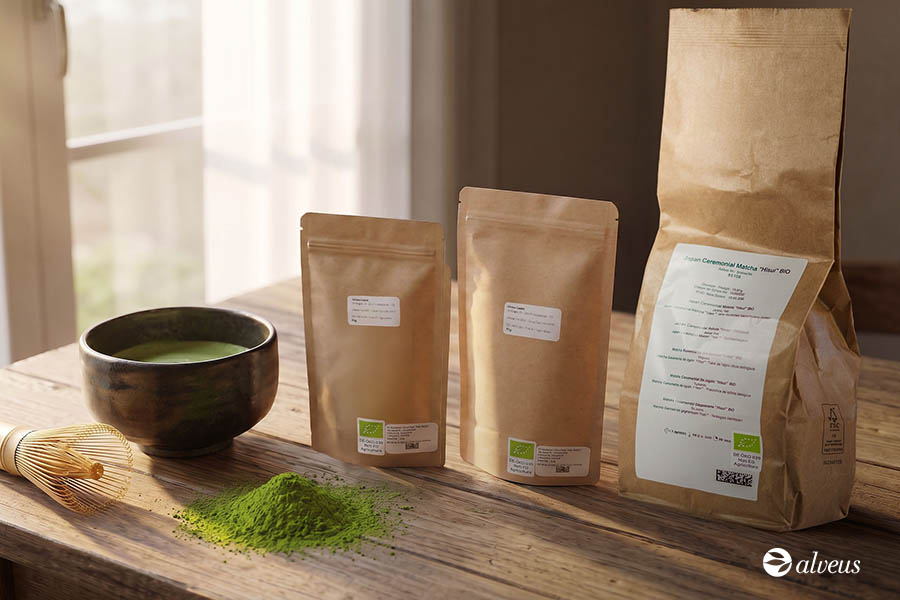
1 kg bag, ideal for bulk sales or for creating your own brand.
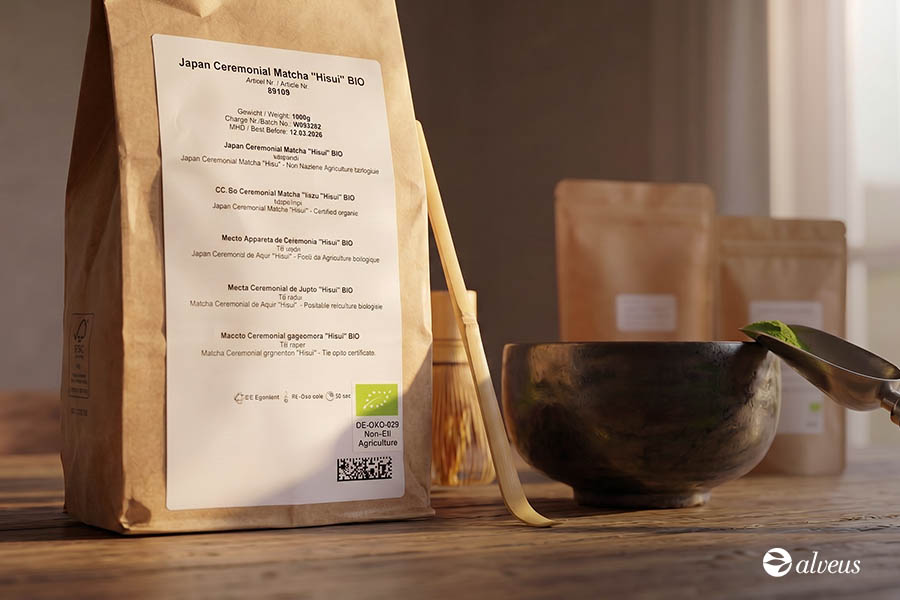
Find our organic Matcha Hisui here in 1 kg bags
The 1 kg format is designed for those who want more flexibility. It is an excellent option for businesses selling in bulk, for projects wishing to package in their formats, or for brands needing a competitive foundation on which to build their identity.
Furthermore, the bag features a paper outer layer, a metallic inner lining and heat-sealed edges – a crucial factor when it comes to matcha. Matcha powder is particularly sensitive to light, air, moisture, and heat. Preservation is no minor matter: it forms part of the product’s actual quality right up until it reaches the customer. With matcha, protecting the product properly means safeguarding its colour, freshness and perceived value.
50g and 100g Doypacks: ready to customise
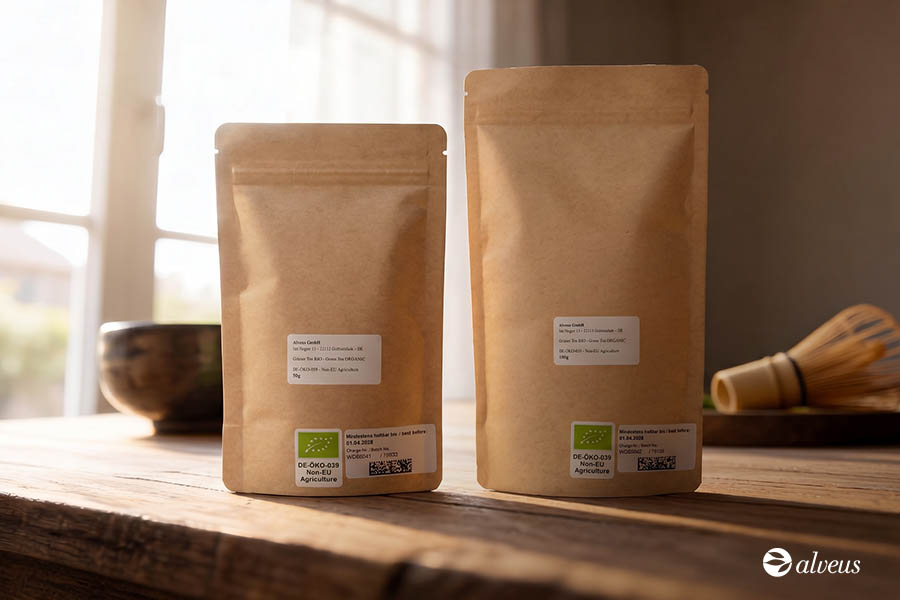
Find our Hisui Matcha here in 50g and 100g bags
For many small shops and brands, one of the biggest obstacles to launching matcha is time and operational expenses. That’s why the 50g and 100g doypacks are such a suitable solution.
It is presented in a self-sealing Kraft paper-coloured doypack, with an aluminium interior and a heat-sealed finish. There are two small labels at the bottom: one containing all the legal information required for traceability (batch number, best before date, quantity, and packer details), and another featuring the BIO logo. This allows the shop to place its own label on the opposite side, providing a retail-ready product without having to develop the entire process from scratch.
This is a particularly attractive solution for:
- shops that want to test the category without committing to large print runs,
- new brands looking for a stylish product that can be launched quickly,
- businesses that value the natural, clean look of the packaging,
- professionals who would like to focus on selling, not on complications.
How to enjoy Hisui Organic Matcha
Organic Hisui Matcha can be enjoyed in many ways, from the most traditional preparation to simple everyday recipes.
Traditional preparation
Matcha does not require a complex preparation process, and it is important to convey this to the end consumer.
To prepare it correctly, simply add approximately one bamboo spoonful of matcha to a bowl, pour in a small amount of water at 80°C, and whisk using brisk wrist movements until dissolved and a light froth forms. Finally, top up with hot water to taste.
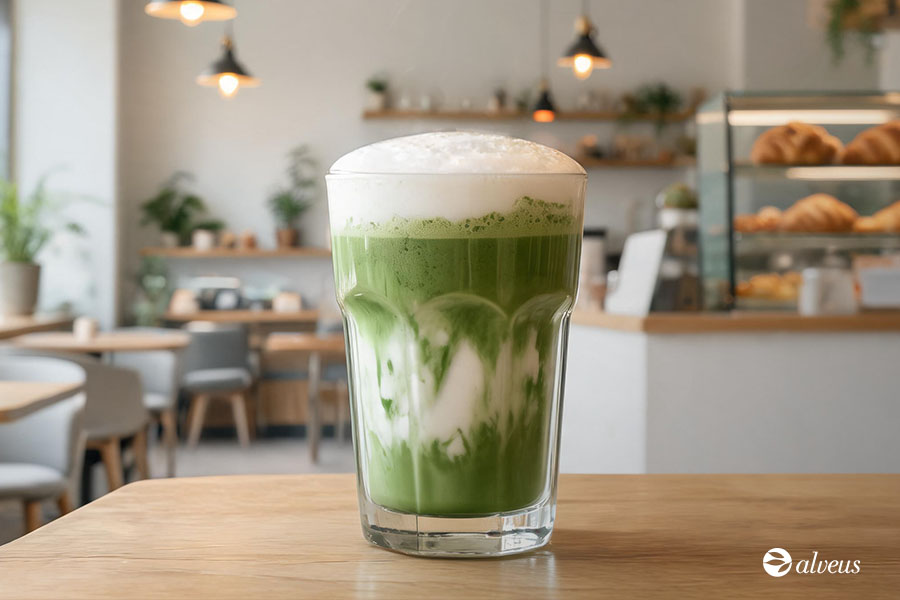
Other ways to enjoy it
It can also be made with plant-based milk, such as oat or coconut milk, or with cow’s milk. In this case, simply whisk in one level tablespoon per glass.
For breakfast, a basic option is to mix half a teaspoon into a glass of orange juice. It can also be added to smoothies and fruit shakes.
What’s more, matcha works very well in cooking. It can be added to cake batters, cupcakes, muffins, biscuits or ice cream, and also used in sauces and dressings. Even a small amount sprinkled over yoghurt adds a unique touch.
5 reasons to have this Matcha in your tea shop
If you’ve read this far, you’ll have noticed that Hisui Organic Matcha combines many of the qualities a tea business needs in this category today. It offers traceability, quality, retail-friendly formats and a highly practical approach for those looking to build their own brand.
So, before we finish, here are five reasons why it deserves a place in your shop.
- Your brand takes centre stage: You can label the bag with your logo and build customer loyalty to your brand. Just stick your label on the bag!
- You can label the dopypack with your logo if you have organic certification and build customer loyalty with your brand.
- The value for money is excellent, making it a product with a wide profit margin.
- Matcha is a constant trend and, according to studies, demand will continue to grow in the coming years.
- The 50g and 100g sizes encourage impulse buying, allowing you to increase your average customer spend. Place it next to the till or on the counter and it will be difficult to resist.