

In a fine-dining restaurant, a luxury hotel, a private club or a signature café, tea cannot appear on the menu as a mere courtesy. It cannot be that discreet section at the end of the experience, consisting of four predictable options and a lacklustre preparation. In a high-end venue, every decision sends a message. The crockery, the bread, the water, the coffee, the wine, the uniform, the lighting… all reflect the soul of the establishment.
That is why a premium tea menu should not be approached as a standard list of hot drinks. It must be understood as an extension of the establishment’s culinary and hospitality offering.
The customer who visits an elite establishment is not simply looking for a drink. They are seeking experience and consistency. If a restaurant takes care over its wine cellar, seasonal produce, sourdough bread and speciality coffee, it makes no sense for tea to be relegated to a generic selection.
This is one of the great opportunities for high-end hospitality. Tea allows you to stand out with elegance, enhance the customer experience and make the most of moments that are often underestimated, such as after-dinner conversations, the end of a tasting menu, afternoon tea, room service, the spa, premium brunch or non-alcoholic cocktails.
In this post, we’re going to outline several factors that will help you build a premium tea menu for a high-end business. If you work with us, a sales consultant will assess your specific needs to help you make this selection in the way that best suits your requirements.
It all starts with the service, not the product
The most common mistake is to start choosing products without having defined the purpose of the service.
In an elite setting, tea must have a clear purpose. It can form part of the pairing for a gourmet menu. It can reinforce the identity of a wellness hotel. Likewise, it can enrich the afternoon tea experience. Furthermore, it can serve as a sophisticated alternative to wine for customers who do not drink alcohol. It can round off a dinner with the same dignity as a spirit, a speciality coffee or a sweet wine.
A five-star hotel may require a broader selection, with service in the lobby, at breakfast, in guest rooms, at the spa and for events. A fine-dining restaurant may prefer a shorter but exceptionally refined selection, designed to pair with specific dishes. A private club may seek exclusivity, rarity and impeccable presentation. A high-end cocktail bar can use tea as a base ingredient for cold drinks, clarified teas, gentle fermentations, mocktails, and signature blends.
When tea is designed as part of a strategy, it ceases to be a secondary category and becomes a positioning element.
Convey discernment through your tea selection rather than abundance.
Whilst in a café or tearoom, an abundance of options is significant, in an exclusive venue, a short but well-considered selection is more highly valued.
Having thirty teas without a narrative, without rotation and without the capacity to serve them does not lend prestige. On the contrary, it can convey a lack of care.
A well-curated tea menu can feature between 10 and 18 varieties, depending on the type of business. The key is to strike a balance between accessibility and depth. There should be familiar options for the casual customer, but also distinctive varieties for those seeking something special.
The selection should cover different styles, intensities, and occasions. A delicate white tea for a subtle experience. A Japanese green tea with an umami profile for seafood or vegetable dishes. A floral or roasted oblong for complex dishes. A full-bodied single-origin black tea for breakfast, pastries or served with milk. A Pu-erh or dark tea for leisurely after-dinner chats. A signature blend to appeal to customers seeking a more immediate aromatic experience. High-quality caffeine-free herbal teas for the evening, spa treatments or customers sensitive to stimulants.
The key is that nothing should seem to have been chosen by default.
Single-origin teas build credibility in this type of menu
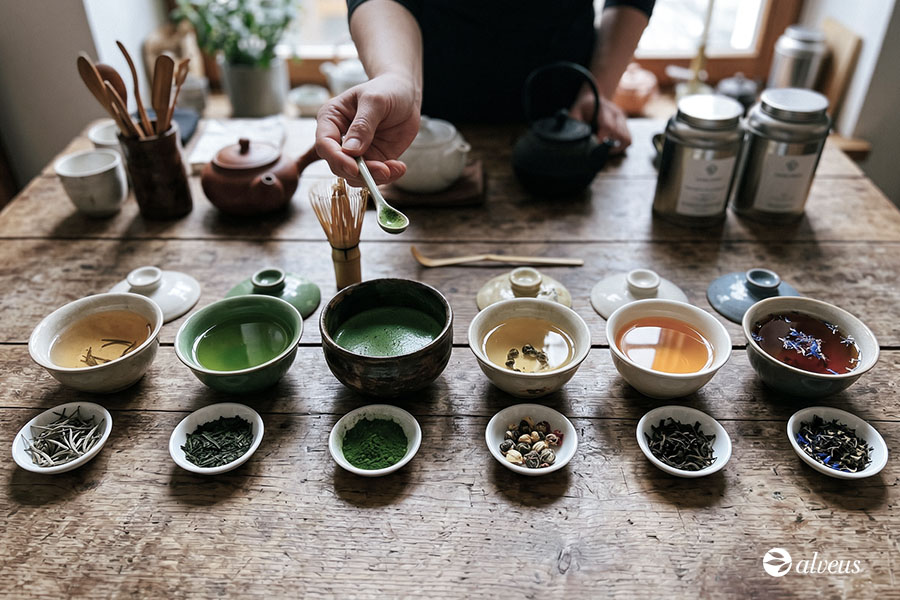
On a high-end menu, single-origin teas are essential. Not because all customers are familiar with them, but because they allow you to discuss origin, terroir, process and culture.
A Chinese Long Jing, a Japanese Gyokuro, a spring Darjeeling, a high-mountain oolong from Taiwan, a black tea from Yunnan, a well-selected Bai Mu Dan or a quality Pu-erh possess a depth that requires no artifice. These are teas that speak through the leaf, their origin and their production method.
These teas offer a language very similar to that of wine. Harvest, altitude, garden, cultivar, oxidation, roasting, ageing, texture, persistence, minerality, natural sweetness, umami. All of this allows the front-of-house team to explain the tea with the same respect with which they would explain a wine.
Blends should be signature creations, not merely decorative mixtures
Although the foundation should be pure teas, there must also be room for a blend. In this case, the selection must be made with even greater care.
It is not about selling the classic mint green tea or a run-of-the-mill chai… In these cases, the recipes are very similar to those of other establishments and, as a general rule, are based on simpler teas and ingredients.
In high-end hospitality, every blend offered must be made with the finest raw materials and use recipes which, whilst their flavour may recall the traditional recipe, have a personality of their own. This can be achieved by choosing blends that use more exclusive teas as a base, natural flavours and ingredients of the highest possible quality.
Referring to the previous example, at Alveus we have developed blends that recreate the classic recipes but with more select teas. This is the case with our Organic Imperial Jasmine, which includes such renowned teas as Dragon Pearls and Silverneedle among its ingredients. Or, for example, our Organic Earl Grey Snail, an Earl Grey that, instead of being based on Assam or Ceylon black tea, uses Chinese Golden Snail black tea – a rarity that is a true delight and surprise for diners!
Organic tea is the standard on a premium menu
Organic teas hold special value in high-end hospitality when integrated thoughtfully. They allow for a broader narrative on quality, traceability, and responsibility.
In a restaurant that focuses on organic produce, plant-based cuisine, local producers or sustainability, an organic tea menu reinforces consistency. In a wellness hotel, it builds trust. In a contemporary luxury setting, it connects with a customer who no longer associates excellence solely with price, but also with origin, impact, and transparency.
Remember that ‘organic’ conveys more than just health. It speaks of origin, transparency, and selection criteria – three values that the premium customer now expects to find in a tea menu as well.
Teas for all guests and occasions
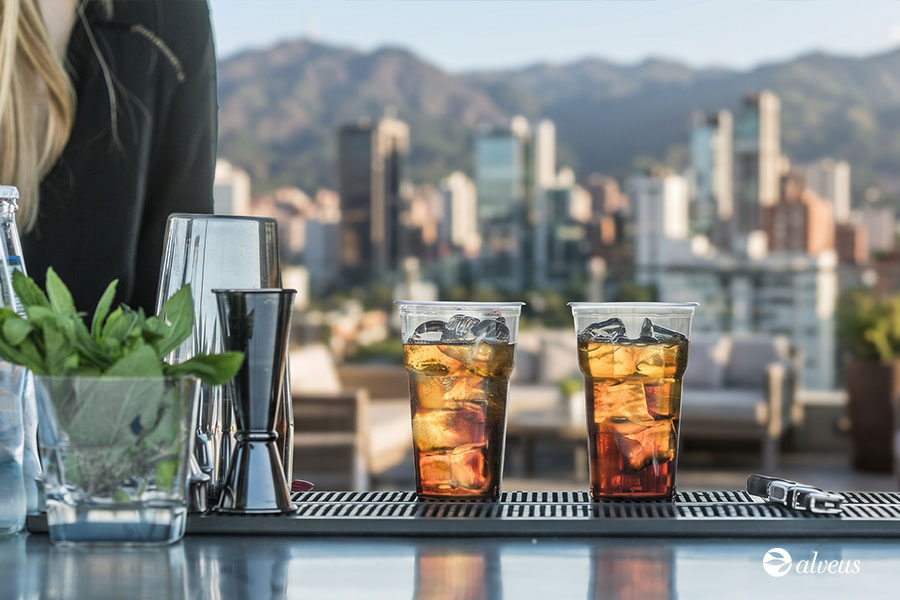
One of the most important and distinctive features is that a concise menu should offer teas to suit all customers and every occasion.
The menu of a premium establishment should include pure teas, blends and caffeine-free infusions. It should also offer teas to be served hot, cold, with milk and for different purposes. For example, a restaurant should have a blend, herbal tea or digestive tea; whilst a spa should offer a relaxing herbal tea.
In many cases, certain teas can serve multiple purposes. For example, a Gyokuro can be served as a pure tea or enjoyed cold over ice; an Assam tea can be served on its own or with milk, and a cinnamon stick can even be added to make it more digestive.
The structure of the menu should guide without overwhelming
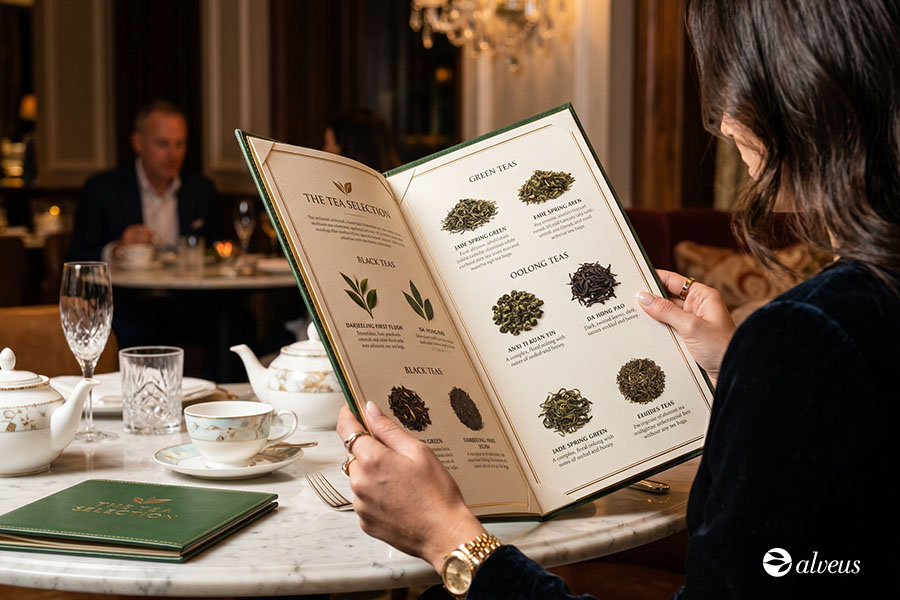
Ideally, the tea menu should include information that guides the customer, accompanying them, but taking care not to overwhelm them.
The language should be refined, clear and sensory. Each entry should indicate the type of tea, its origin if this adds value, its sensory profile and the recommended time of day (depending on the type of business). On a restaurant menu, a pairing suggestion may also be included. In a hotel, it can indicate whether it is ideal for morning, afternoon, evening or the spa… In a cocktail bar, it can specify whether it works best served chilled or as a base for a mocktail.
The menu should help the customer decide based on pleasure, not on the fear of making a mistake.
Some of the recommended terms, which guide and create desire, are vegetal and umami, floral and silky, toasty and enveloping, spicy and structured, clean and mineral, sweet with no added sugar, intense and persistent… The rest of the information should be provided by the team if requested.
Other factors to consider for a high-quality tea service
It is not just the selection of tea that is important for providing a good experience in exclusive hospitality establishments. There are several factors which, if not taken care of, could ruin the experience entirely.
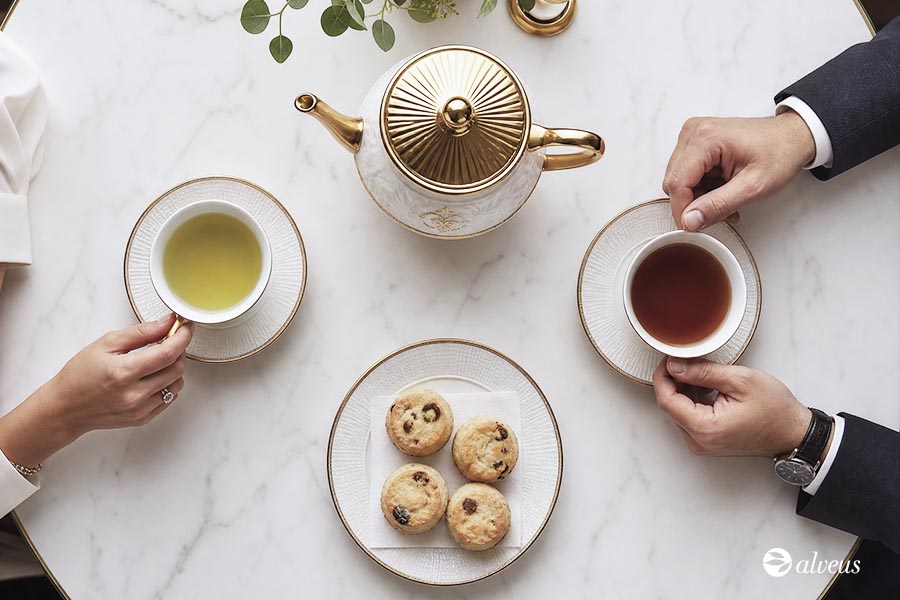
Preparation must be standardised to the level of a professional kitchen
One of the most important aspects is preparation. In a high-end establishment, there can be no improvisation in the tea service.
The water temperature, weight, steeping time, type of teapot, removal of the leaves and serving temperature must all be defined. Just as a kitchen weighs, measures, cuts and plates, the tea service must have a clear methodology.
This requires training, but also operational design. The system must be excellent and workable during service. The fine dining sector thrives on that balance between beauty and precision.
Not just any water will do
Water with excessive chlorine, unbalanced hardness or foreign flavours can dampen the aroma, toughen the texture and completely alter the perception of the tea. This is particularly evident in delicate green teas, white teas, fine oolongs and high-end teas with subtle nuances.
An establishment that invests in good tea must also check the quality of the water. Filtration, mineralisation, cleaning of kettles, equipment maintenance and temperature control are all part of the standard.
The customer may not be able to explain why a cup tastes flat, harsh, or heavy. But they can sense it. In the luxury sector, it is these small nuances that distinguish a satisfactory experience from a flawless one.
Choose the right tableware and consider the table presentation
Tea service in an elite setting must have presence. The teapot, the cup, the tray, the strainer, the timer, the water jug, the way the leaves are presented and the manner of service all add value.
Each type of establishment must find its own language. A classic hotel might opt for fine porcelain and ceremonial service. A contemporary restaurant might choose minimalist pieces, handcrafted ceramics or thermal glass. A cocktail bar might serve cold tea with a more technical and modern aesthetic. A spa might seek out warm materials, visual calm and a more sensory service.
The service team must know how to sell without sounding like they’re reciting a script
Staff training in tea is crucial. It is not enough for the team to know how to prepare tea. They must know how to recommend it naturally.
In a high-end restaurant, the waiter shouldn’t simply ask if the customer wants green or black tea. They should be able to offer guidance based on the occasion, the dish, the customer’s taste and the desired intensity.
The recommendation may be simple, but it must sound confident. Something light and floral to finish on a light note. A full-bodied black tea, if they wish to replace coffee. A roasted oolong if they are looking for a more enveloping cup. A herbal infusion if they prefer something caffeine-free. A Pu-erh if they want a deep, digestive finish from a sensory perspective…
Staff do not need to show off their knowledge. They need to convey confidence.
Storing tea
A premium tea can deteriorate quickly if stored incorrectly. This is particularly serious in the hospitality industry, where coffee, spices, cooking, humidity, heat, storage rooms, cleaning products and constant movement all coexist.
Tea must be stored in airtight, opaque, clean containers, away from strong odours. Stock rotation must be carefully managed. Quantities should be purchased based on consumption patterns, not on impulse. The most delicate teas, such as Japanese green teas or certain white teas, require special care.
A premium tea list must have a dynamic
A high-quality tea menu should not remain static for years. It must have a stable core and a dynamic element.
The core provides consistency. Seasonal additions bring novelty and conversation. First spring harvests, floral teas for the warmer months, roasted oolongs in autumn, spiced blends in winter, iced teas in summer…
This evolution allows the team to have new conversation points and ensures that regular customers perceive movement. In the luxury sector, novelty must feel carefully curated, not opportunistic.
The importance of choosing the right tea supplier for an exclusive hospitality business
The supplier chosen for your hospitality business should help define a selection consistent with the type of establishment, avoid unbalanced menus, ensure consistent quality and provide expertise on preparation, storage, rotation, and presentation.
Working with a specialist supplier allows you to build a more robust, more profitable and easier-to-promote menu for your front-of-house team.
At Alveus, we support professionals who want to treat tea with the same care as other premium categories. Our wide selection of teas and herbal teas, the depth of our organic range and our experience in creating blends for businesses allow us to develop offerings with personality, quality and commercial potential.
A good tea menu should not only be appealing to the diner. It must also be coherent, practical, and profitable for the establishment.