

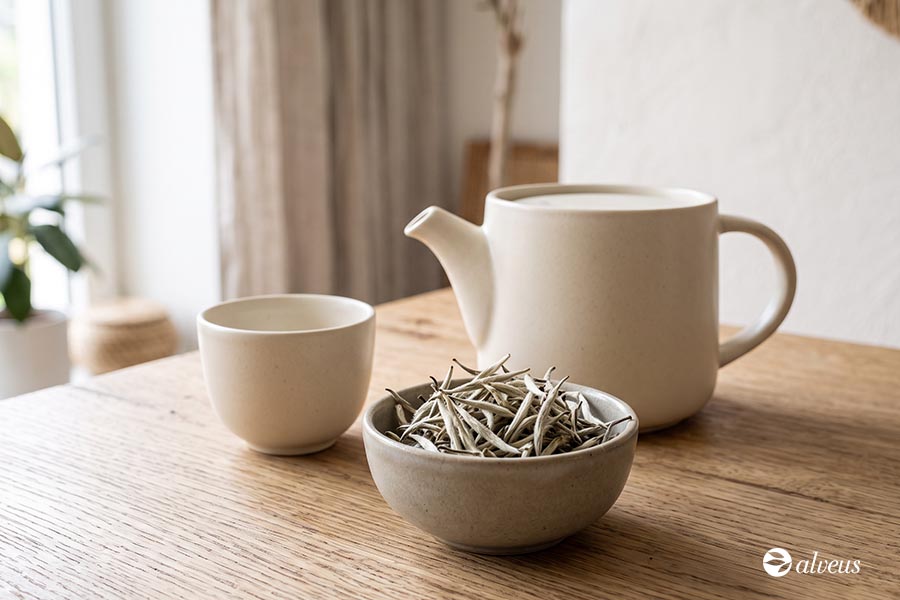
White tea is often associated with delicate infusions, silvery leaves and an extremely simple production process. However, there is far more diversity within this category than meets the eye. A Bai Hao Yin Zhen made solely from buds can be light and silky, whilst a Shou Mei can offer a much more structured, sweet and mature cup.
All of them come from Camellia sinensis, just like green tea, oolong or black tea. What sets them apart is mainly the raw material selected and a production process based on prolonged withering and the drying of the leaves.
Here are some of the most frequently asked questions to help you better understand white tea, choose it and brew it correctly.
What is white tea and from which plant does it come?
White tea is one of the major categories of tea produced from Camellia sinensis.
It does not, therefore, come from a different plant to green, black or oolong tea. What differs is the way the leaves are harvested and processed.
Its traditional production is particularly simple. The freshly picked leaves or buds are withered for an extended period and then dried, usually avoiding processes such as the intense rolling or early fixation characteristic of green tea. During this long withering process, slight oxidation occurs and numerous aromatic compounds develop.
Why is it called white tea?
The name does not derive from the colour of the infusion.
It relates mainly to the appearance of the young buds of certain varieties of Camellia sinensis, which are covered by a fine layer of whitish or silvery trichomes.
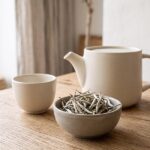
These tiny hairs are particularly visible in teas such as Bai Hao Yin Zhen or Silver Needle, which are made exclusively from buds.
Cultivars traditionally grown in Fujian, such as Da Bai, produce buds and young leaves with a thick coating of these trichomes. Hence the silvery appearance that ultimately gave its name to the entire category.
The liquor of a white tea, on the other hand, usually ranges in colour from very pale yellow to golden, amber or even orange in more mature styles.
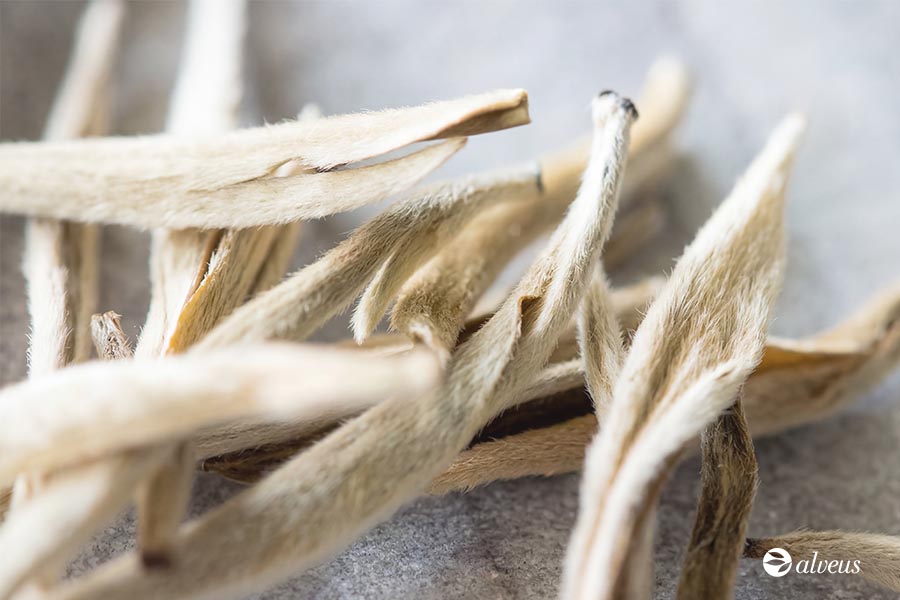
Yin Zhen Silverneedle ORGANIC – Product code 82736 by Alveus
Why do some white teas have so many downy buds?
This ‘fuzz’ consists of trichomes, tiny natural hairs that cover the buds and the youngest leaves. They are not mould, dust or a defect.
Their function in the plant is related to protecting young tissues from environmental factors and certain organisms.
Some cultivars used to produce white tea develop a particularly abundant covering, which is why the buds take on a silvery appearance. In Bai Hao Yin Zhen, this is one of its key visual characteristics.
How is white tea produced?
The traditional production of white tea is based primarily on two processes: withering and drying.
Harvest
Depending on the style, either buds alone or various combinations of buds and leaves may be harvested. Handling must be careful, as breaking or bruising the leaves accelerates oxidation.
Wilting
The leaves are spread out in thin layers and slowly lose a significant amount of their moisture.
This process can take place outdoors, in the shade, in the sun or in facilities with controlled temperature, humidity and air circulation. At this stage, some of the water is removed, and numerous biochemical changes take place, which are responsible for the final aroma and flavour.
Drying
When the producer considers that withering has reached the desired stage, the leaves are finished off by drying using hot air, ovens or other systems.
Unlike green tea, early fixation is not usually carried out to deactivate the enzymes responsible for oxidation. Consequently, natural oxidation may occur during withering.
Is white tea oxidised?
Yes. White tea may undergo some oxidation, although this is usually much less pronounced and develops differently from that in black or oolong tea.
As there is generally no early heat fixation, the enzymes in the leaves remain active during withering. This allows slow, natural oxidation to take place.
The difference lies in the fact that the leaves are handled very little. They are not rolled to break the cells and accelerate oxidation, as is the case with black tea.
It is therefore more accurate to describe white tea as a tea that is lightly oxidised during withering, rather than considering it completely unoxidised.
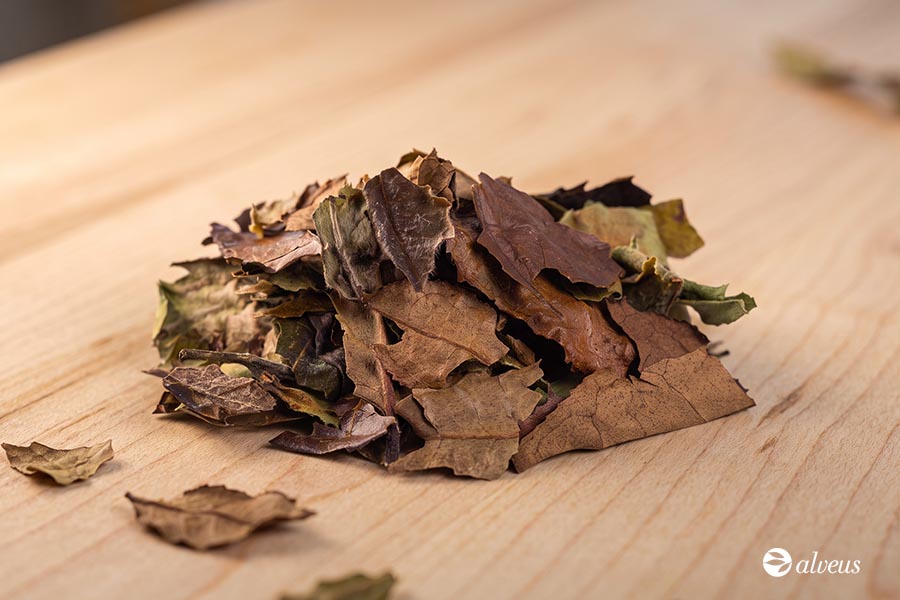
Pai Mu Tan Special Organic – Product code 82747 by Alveus
What is the difference between white tea and green tea?
Both come from the Camellia sinensis plant, but they are processed differently.
In green tea, heat is applied shortly after harvesting using steam, a wok, a drum or other methods. This process, known as fixation, deactivates the enzymes responsible for oxidation.
In white tea, this fixation is not traditionally carried out at the start of the process. The leaves are left to wither for an extended period and are then dried.
This difference in processing affects their character:
- Green tea usually has more distinctly vegetal, herbaceous, marine, nutty or toasty aromas, depending on its origin and production method.
- White tea tends to develop softer, more mature notes of flowers, honey, hay, fruit, dried herbs and light wood.
Is white tea the least processed tea?
It is generally considered the category of tea involving the simplest processing, as its traditional production essentially boils down to withering and drying.
However, to say that it is the ‘least processed’ tea might lead one to believe that very little work goes into its production. Controlling the withering process correctly can take many hours or days. It is a challenging process, and experience is needed to produce a great white tea.
What are the main types of white tea?
The traditional classification of Chinese white tea includes several styles defined mainly by the part of the plant used and the time of harvest.
Bai Hao Yin Zhen or Silver Needle. Made exclusively from young buds covered in trichomes.
Bai Mu Dan or White Peony. This usually consists of a bud accompanied by one or two young leaves.
Gong Mei. Contains a higher proportion of leaves and fewer buds.
Shou Mei. Produced from more mature leaves, it usually has a fuller body and a more intense flavour profile.
In addition to these, there are styles developed in other regions, such as Yue Guang Bai or Moonlight White, which is characteristic of Yunnan.
White teas are now also produced in India, Nepal, Sri Lanka and numerous other countries, meaning that the category can no longer be understood exclusively through the traditional Fujian styles.
Where is the best white tea produced?
There is no single place that objectively produces ‘the best’ white tea.
However, Fujian is the fundamental historical reference point for this category, particularly the counties of Fuding and Zhenghe.
It was there that styles such as Bai Hao Yin Zhen, Bai Mu Dan, Gong Mei and Shou Mei were developed.
Fuding and Zhenghe also have their own cultivars and processing traditions, so Fujian white tea should not be regarded as a uniform product either.
Nowadays, excellent white teas can be found in Yunnan, Nepal, Darjeeling, Sri Lanka and other regions.
What are the differences between Fujian white tea and Yunnan white tea?
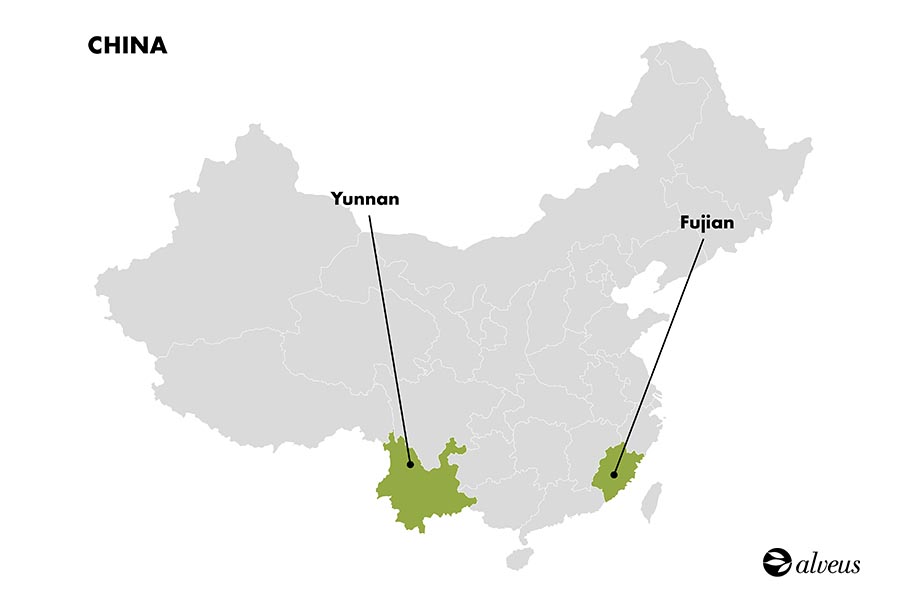
These are two of the most interesting varieties of Chinese white tea.
White tea from Fujian
Fujian, particularly Fuding and Zhenghe, represents the classical tradition.
Common cultivars of Camellia sinensis var. sinensis are found here, such as various types of Da Bai, and styles such as Bai Hao Yin Zhen or Bai Mu Dan.
In the cup, we can detect floral, sweet, honeyed, hay-like, herbal, white fruit and delicate nutty notes.
Yunnan white tea
In Yunnan, it is common to work with large-leaf plants related to Camellia sinensis var. assamica.
One of its best-known styles is Yue Guang Bai or Moonlight White, produced using a distinctive withering process. Its leaves may display a very characteristic contrast between dark surfaces and areas covered in abundant silvery down.
The flavour profiles tend to be somewhat deeper and may be reminiscent of honey, ripe fruit, apricot, dried fruit, flowers, wood and mild spices.
What does white tea taste like?
There is no single flavour of white tea.
Depending on the raw material, origin, cultivar, harvest and processing, notes may emerge reminiscent of:
- White flowers.
- Rose.
- Honey.
- Hay.
- Fresh or dried herbs.
- Melon.
- Pear.
- Apricot.
- Peach.
- Dried fruit.
- Almonds.
- Cereals.
- Light wood.
- Mild spices.
A young Silver Needle is usually particularly light, sweet and silky.
Bai Mu Dan, also known as Pai Mu Tan, can offer greater floral and fruity intensity.
Shou Mei usually has more body, ripe notes and a flavour profile that can develop into dried fruit, honey and wood.
Therefore, to associate all white teas with an extremely light cup would be to focus on only one aspect of the category.
How is white tea brewed correctly?
There is no single way to brew white tea, as a Silver Needle and a Shou Mei have very different profiles.
As a starting point, you can use 12 to 15 grams per litre, with a water temperature of between 70 and 80 °C and an infusion time of between 2 and 5 minutes. It all depends on the variety of tea.
Teas made from mature leaves, such as some Shou Mei, can respond very well to high temperatures.
Can white tea be steeped several times?
Yes. Good white teas can usually be infused several times.
This works particularly well with whole leaves and with brewing methods that use a high ratio of tea to water.
A Silver Needle may start off very delicate and gradually develop more vegetal, floral and sweet notes.
Bai Mu Dan and Shou Mei tend to evolve even further between infusions due to the presence of leaves of different sizes and degrees of maturity.
If brewed in a small teapot or gaiwan, you can start with short steeping times and gradually increase them.
Can white tea be drunk with milk, sugar or lemon?
Technically, yes, you can, although it is not usually the best way to appreciate the most delicate white teas.
Milk can easily mask the aromas of a Silver Needle or a fine Bai Mu Dan. On the other hand, some intense Shou Mei or blends based on white tea can cope with it better. Given the nature of this type of tea, it must be said that milk and white tea do not go well together.
Sugar can be added, but it is not usually necessary with good-quality teas as many have a considerable natural sweetness.
Lemon works better with full-bodied styles than with a very delicate Silver Needle. Its acidity can quickly overpower the floral profile of the brew.
How much caffeine is there in white tea?
There is no fixed amount. The caffeine content in a cup depends on factors such as:
- Cultivar.
- The part of the plant used.
- Harvest date.
- Proportion of buds.
- Amount of tea.
- Water temperature.
- Steeping time.
A recent study analysing different types of tea and preparation conditions found that white tea samples contained approximately 5.8–30.6 mg of caffeine per 200 ml, depending on the preparation method and the product analysed.
Another study on Fuding white teas also found that increasing the water temperature significantly increased caffeine extraction. Therefore, giving a single figure such as ‘a cup of white tea contains X milligrams’ is rather imprecise.
Does white tea contain less caffeine than green tea and black tea?
Not necessarily. This is one of the most widespread myths about white tea.
An analysis of 37 commercial products found average caffeine concentrations in the dried leaves of:
- White tea: 16.79 mg/g.
- Green tea: 16.28 mg/g.
- Black tea: 17.73 mg/g.
The average differences were therefore much smaller than is commonly thought.
Furthermore, young shoots can be particularly rich in caffeine. It is therefore incorrect to assume that a Silver Needle contains little caffeine simply because its flavour is delicate.
What are the properties and benefits of white tea?
Many people say white tea is the richest in antioxidants, aids weight management, or supports cardiovascular health. And whilst it is true that, like all teas, it is a healthy drink, we like to refer to the numerous scientific studies being carried out around the world.
White tea contains various polyphenols and catechins, including EGCG, as well as caffeine and L-theanine. These compounds have attracted interest due to their antioxidant activity and other potential biological effects. However, their concentration varies greatly depending on the type of tea, the harvest and the processing method. A study comparing different white and green teas found wide variations between samples and showed that some white teas could contain similar amounts of catechins to certain green teas. It is therefore incorrect to state in general terms that white tea is ‘the tea with the most antioxidants’. See study on PubMed
Nor does the fact that these substances exhibit antioxidant activity in the laboratory automatically mean that they produce the same effect in the body. In a randomised trial involving 70 healthy adults, the consumption of 600 ml of white tea increased the blood concentration of several catechins, demonstrating that these compounds are absorbed. However, the researchers did not observe a significant improvement in several markers of oxidative stress and noted that the study did not allow them to conclude that white tea had a protective effect on health. See study on PubMed
Possible effects on metabolism are also being investigated. A small pilot study involving 32 healthy women observed a temporary increase in resting energy expenditure following the consumption of white tea, reaching approximately 8.7 per cent after three hours. This is an interesting finding, but as it was an acute effect observed in a small sample, it does not prove that drinking white tea aids weight loss.
As we mentioned at the start, white tea can form part of a healthy diet and provides bioactive compounds of interest, but specific clinical research into its benefits in humans remains limited and does not allow us to attribute any specific preventive or therapeutic properties to it. See study on PubMed
Can you drink white tea during pregnancy?
White tea contains caffeine, so during pregnancy it should be counted as part of your total daily caffeine intake.
The EFSA considers that an intake of up to 200 mg per day from all sources does not pose a safety risk to the foetus. The American College of Obstetricians and Gynaecologists also uses 200 mg per day as a benchmark for moderate consumption.
This includes all caffeine from:
- Tea.
- Coffee.
- Chocolate.
- Soft drinks.
- Energy drinks.
- Certain medicines or supplements.
How should white tea be stored to preserve its aroma and quality?
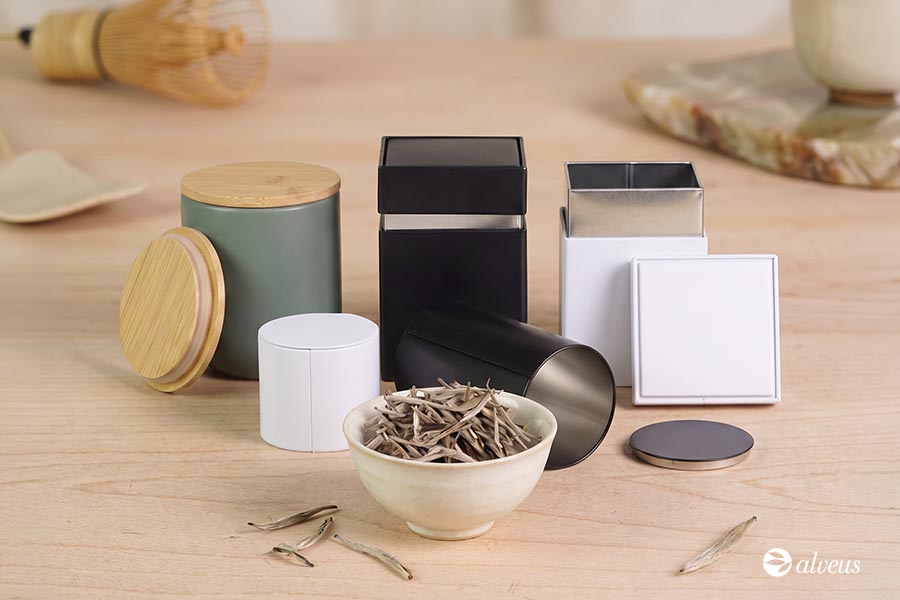
White tea must be protected primarily from five factors:
- Moisture. Dried leaves easily absorb water from the air.
- Oxygen. Prolonged exposure can gradually alter the aroma and flavour.
- Light. Direct light, in particular, accelerates certain degradation reactions.
- Heat. It should be stored at a relatively stable temperature and away from sources of heat.
- Odours. Tea absorbs aromas very easily, so it should not be stored alongside coffee, spices, perfumes or other strongly scented foods.
For normal consumption, it is best to use an airtight, opaque and clean container, stored in a cool, dry place.