

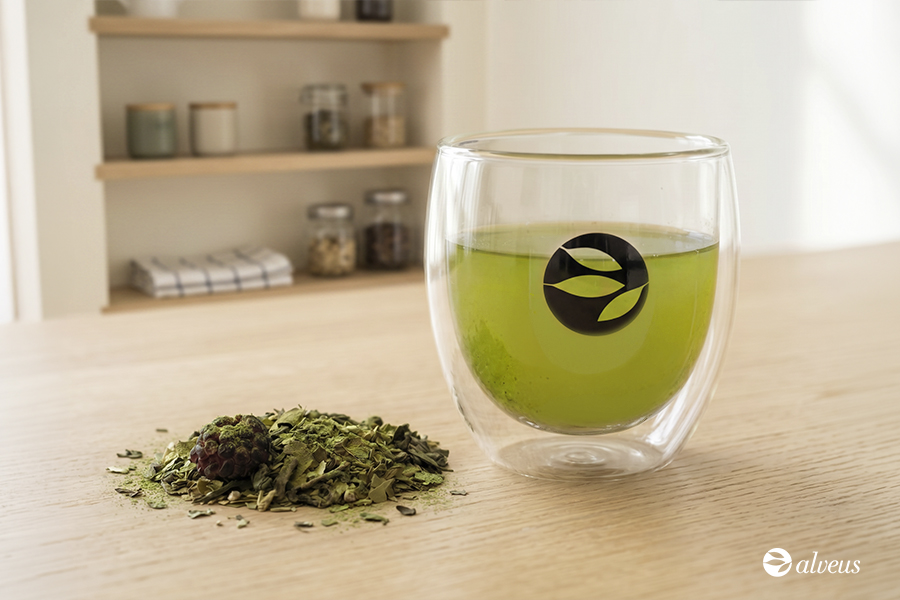
Talking about matcha in tea blends is not just about a green powder that ‘dresses’ or adorns a mixture.
When used correctly, matcha transforms the sensory structure of the blend in very specific ways, as it alters the colour, changes the texture, intensifies the vegetal profile, enhances the umami sensation and lengthens the finish.
But be careful! It can also ruin a blend if used without understanding what it does to the base tea. In other words… matcha is not a mere garnish. It is an ingredient in its own right and must be understood in order to use it to its full potential.
In the world of blending, a blend is not justified simply for being eye-catching, but for achieving a better, more expressive or more coherent cup than its individual components would offer on their own. That idea lies at the heart of serious tea blending, which involves mixing to achieve a profile that would not be possible with a single tea or to create a more complete experience, always without losing sight of balance. In fact, blending can be used precisely to achieve a flavour that a single tea does not provide, and in Japanese green teas, the combination of sencha and matcha stands as a very clear example of a carefully considered blend.
The problem is that matcha is often used as a cosmetic or commercial gimmick, that is, to make the blend look greener, more ‘premium’ or more Japanese. That may work visually, but it does not necessarily result in a better cup of tea.
If one wishes to use matcha as a genuine ingredient, one must understand what it contributes to the blend and what it demands of the other components.
Matcha’s first contribution: visual identity
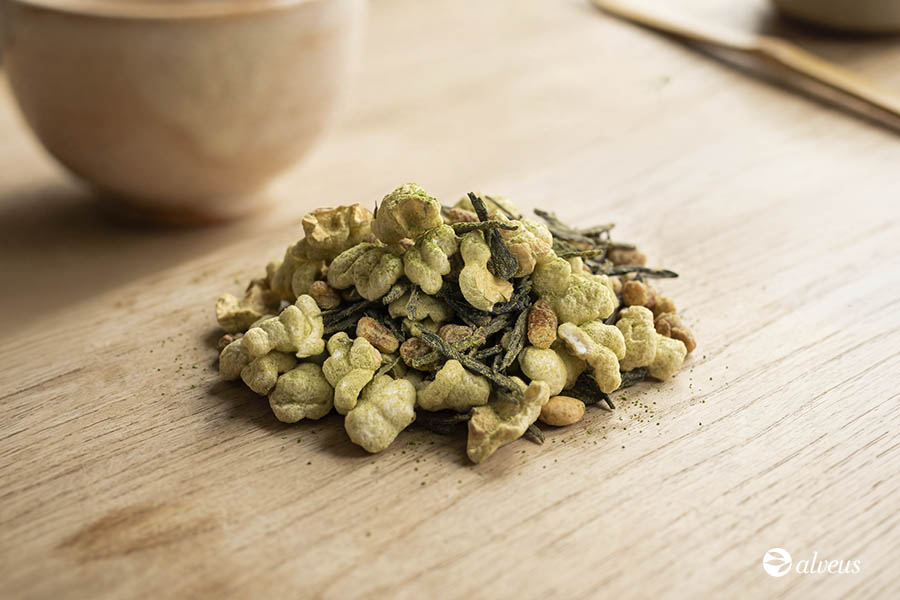
he most obvious contribution of matcha is visual. When dry, its fine powder coats the leaves and other ingredients, unifying the appearance of the blend and immediately creating a perception of intensity and freshness. In a genmaicha made from sencha and matcha, for example, the powder coats the leaves and toasted rice, giving the blend a bright, uniform green colour. In the cup, that same matcha makes the liquor cloudy, almost opaque, setting it apart from the usual transparency of many green teas brewed using leaves alone.
This has an important implication for product design: matcha communicates its qualities even before the tea is brewed. The consumer sees a more vivid green and expects a more intense, more vegetal, more enveloping experience. In other words, matcha not only changes the drink; it changes the expectation. In commercial blends, this explains part of their appeal.
That said, this visual appeal also comes with certain expectations. If the colour suggests a rich, full-bodied cup but the result is flat, it will cause more disappointment than delight.
The second contribution: more body and a distinct texture
Matcha does not act as a light aromatic ingredient, the sort that perfumes a base. It also acts on the very substance of the blend. As it is a very fine powder that remains suspended in the liquid, it not only adds flavour, but also provides thickness, density and a different sensation on the palate.
Tasting notes for matcha describe it as having an opaque, cloudy liquor, great body, a thick texture and a long finish; in the case of Gyokuro, a close sensory relative due to its intense umami and vegetal profile, a velvety texture even emerges, almost as if it were a soup. And in Genmaicha with matcha, it is precisely the powder that is responsible for a velvety mouthfeel and a fuller, rounder finish.
Many green teas, especially if they are fine, delicate or have a light liquor, can lack body when blended with aromatic ingredients. Matcha compensates for this. It adds ‘weight’ on the palate. It thickens the cup. It ensures the blend does not rely solely on aroma to convey a sense of quality.
The third contribution: Increase in the vegetal and marine profile
Matcha also pushes the blend towards a very defined profile. Its aromatic and flavour profile revolves around raw or cooked vegetables, seaweed, grass, marine notes and umami. In tasting notes, one finds hints of grass, seaweed, boiled chard, artichoke and steamed vegetables, alongside a very pronounced umami and salty flavour.
This means that, when incorporated into a blend, matcha does not merely accompany the other elements, but rather steers the blend’s profile towards a more Japanese, greener, more marine and more umami identity.
In blends based on sencha or bancha, this is usually consistent, as they share part of that sensory territory. In fact, Japanese greens are generally characterised by being more intense and astringent than many Chinese greens, and by presenting notes of raw vegetables, seaweed and lemon. Chinese greens, on the other hand, tend to be milder, sweeter, more delicate and with more cooked or toasted notes.
This distinction matters a great deal. If you add matcha to a Japanese base, you usually reinforce something that already exists. If you add it to a delicate Chinese base, the matcha is likely to impose a new direction and mask part of the original character. That doesn’t mean it should never be done, but rather that you must decide whether you are seeking to enhance a sensory profile or alter it.
The fourth contribution: persistence and length
Persistence does not always receive the attention it deserves in blending, but it is one of the clearest differences between an acceptable blend and a truly good one. Matcha helps a great deal here. Due to its aromatic concentration, its amino acid and catechin content and, above all, the physical presence of the powder in the liquid, it prolongs the experience.
In tasting terms, we could say that Matcha is a long-finish drink; in gyokuro, it has a thick, velvety and persistent texture; and in genmaicha with matcha, it offers a full, smooth and soothing finish. In other words, it not only leaves a longer-lasting impression, but also sustains the sensation of the blend from the initial taste right through to the finish.
This provides the practical advantage of allowing other ingredients in the blend to rest on a longer-lasting base. A note of toasted rice, a marine note or a well-chosen herb do not simply appear and disappear, but find a foundation on which to develop in the mouth.
The fifth element: structure and cohesion
Not all ingredients in a blend serve the same purpose. Some contribute aroma. Others provide contrast. Others add sweetness, freshness or toasty notes. Matcha can act as a structural ingredient as it binds, fills and provides coherence.
Tea, by its very nature, has a great capacity to absorb and work with flavours. It is, in fact, considered a particularly suitable base for flavouring and blending because its subtleties do not overwhelm its companions, as can happen with coffee. This capacity allows for the creation of complex blends, but it also demands great precision, as combining too many elements with a strong character causes the blend to lose clarity.
Here, matcha is delicate because it has so much character. If used as the star ingredient, the rest of the blend must be organised around it. If it is intended to be merely a detail, the dosage must be low and very carefully controlled. What doesn’t work is using it solely to make the blend look more appealing, because in the cup its presence is immediately noticeable and it tends to dominate.