

Camomile is one of the most popular ingredients worldwide; so much so that one might say it needs no introduction.
Its floral aroma, its apple-like notes, and its identity deeply rooted in the world of herbal infusions make Matricaria chamomilla a particularly interesting flower, both for sale on its own and for use in herbal teas and tea or rooibos blends.
Known for centuries and present in a wide variety of cultures, behind its apparent simplicity lies a raw material with a personality all of its own.
What is camomile?
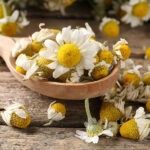
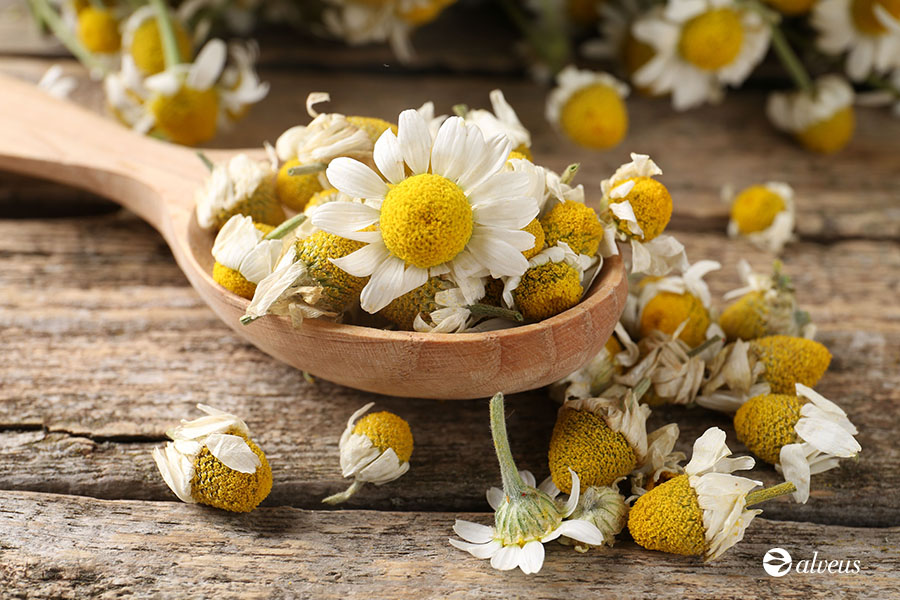
Camomile belongs to the Asteraceae family, the same botanical family as plants such as calendula, sunflower and echinacea. Its small flower heads, with white petals surrounding a yellow centre, resemble tiny daisies.
However, simply referring to ‘camomile’ can be misleading, as various species are marketed under this common name.
In this case, we are referring specifically to Matricaria chamomilla L., a species that also appears in numerous publications under the name Matricaria recutita L. or Chamomilla recutita.
It is an annual plant native to temperate zones and widely distributed across Europe and Asia. It can grow to around half a metre in height, and it is the flower heads that are harvested and dried for subsequent use.
An aroma reminiscent of apples
One of camomile’s most distinctive features is its aroma.
It is floral, warm and slightly herbaceous, but also possesses sweet and fruity notes that have traditionally been compared to apple. Recent studies on its volatile compounds also identify fruity notes as an important part of its aromatic profile.
On the palate, it retains that pleasant sensation. It may exhibit a natural, plant-like sweetness accompanied by a slight bitter note, particularly when the concentration or infusion time is increased.
It is precisely this balance between sweetness, floral notes, grassy notes and a slight hint of bitterness that accounts for much of its versatility. Camomile has enough character to stand out, but it does not tend to be overpowering within a blend.
Its natural constituents include flavonoids such as apigenin and various volatile compounds, amongst them derivatives of bisabolol and farnesene. The exact composition may vary depending on the origin, cultivation, harvest and processing of the raw material.
A plant with centuries of history
Humankind’s relationship with camomile dates back a very long time.
There are references to its use in various European and Mediterranean cultures, and historically, it has been associated with both medicinal preparations and herbal drinks. The Ebers Papyrus, one of the best-known medical texts from Ancient Egypt, lists camomile amongst the plants used in its preparations.
Over time, this traditional plant also became one of the most recognisable flavours in the world of herbal teas.
The European Medicines Agency lists the flower of Matricaria recutita in its monographs on traditional herbal medicinal products and recognises a long history of use, including, amongst other things, for minor gastrointestinal complaints.
From the perspective of a tea shop or a brand, its value extends far beyond this tradition. Camomile is instantly recognisable, conveys a sense of familiarity and allows for the development of a wide variety of products without losing its identity.
Camomile flowers for brewing on their own as a herbal tea
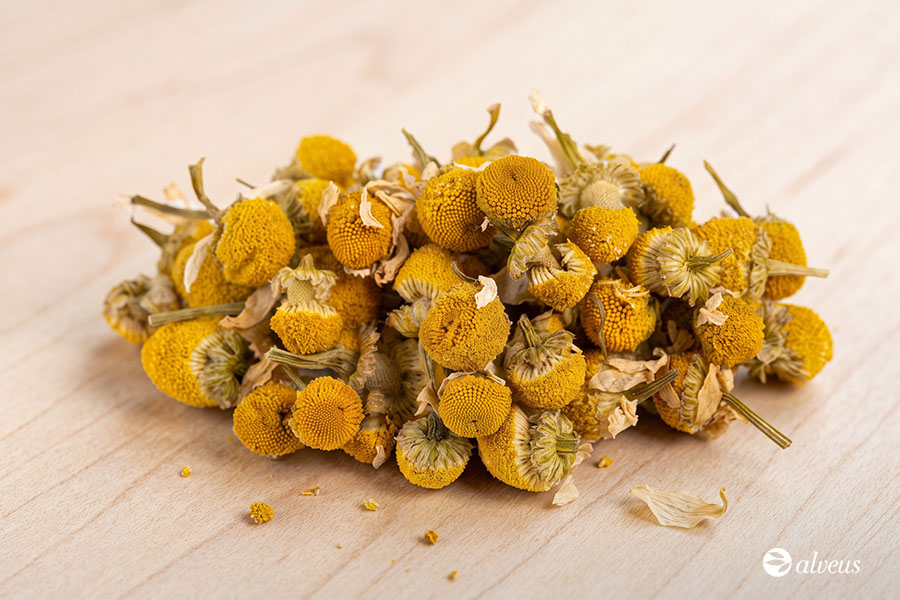
Organic camomile Flowers – Ref. 82553 by Alveus
When the raw material has an attractive visual appearance, marketing camomile in bloom allows the consumer to see directly what they are buying.
This is particularly important in specialist bulk-sale shops. A well-preserved flower makes a big impression long before it reaches the cup. The contrast between the yellow of the flower head and the remnants of white petals gives it a natural, recognisable appearance that is immediately associated with a traditional herbal tea.
Once brewed, camomile produces a golden-hued drink with a very distinctive floral and fruity aroma. Its flavour is relatively mild, with honeyed, herbaceous and ripe apple notes, accompanied by a slight bitterness that adds depth.
It does not necessarily require other ingredients to be appealing. That is precisely one of its commercial advantages.
For a loose-leaf tea shop, it can fill the niche of classic single-ingredient infusions. For a private label, it allows for the development of a simple and easily identifiable product, where factors such as origin, the appearance of the flowers and the aromatic quality of the raw material take centre stage.
What does camomile bring to a herbal tea or herbal blend?
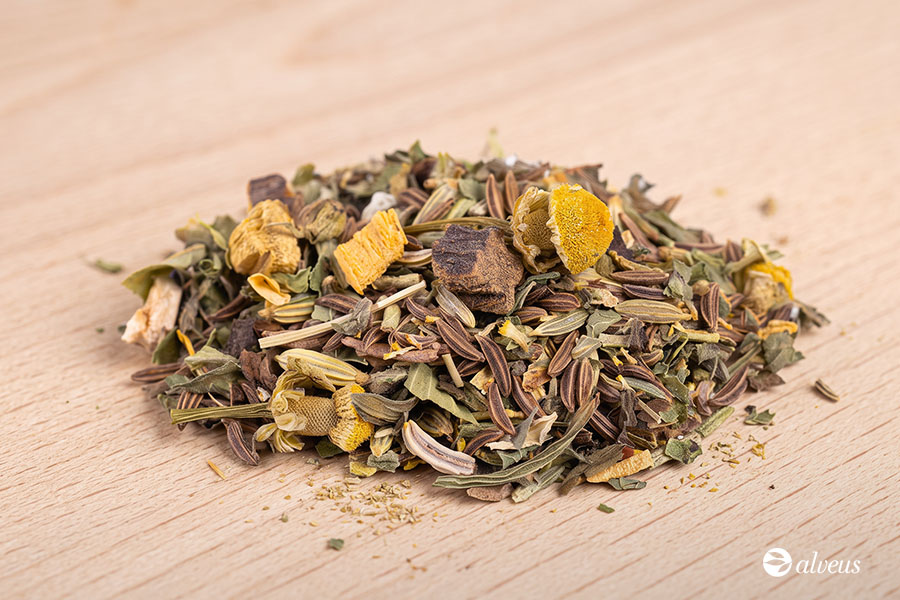
Bon Appetit BIO – Ref. 82563 by Alveus
In a herbal tea, camomile takes on a different role. It no longer has to take centre stage, but rather blends in with fruits, herbs, flowers and spices. And that is where it proves particularly versatile.
Sensory-wise, it adds smoothness and roundness. Its floral notes help to bring together ingredients that might otherwise seem quite different, and its sweet, apple-like flavour easily complements fruity elements.
It pairs particularly well with citrus profiles such as lemongrass, verbena or orange peel. It also complements sweet and spicy ingredients such as cinnamon, fennel or aniseed, and can soften recipes featuring plants with herbaceous or slightly bitter notes.
There is also an important visual aspect. A herbal tea made solely from leaves and pieces of fruit can be brightened up by the addition of camomile’s small yellow and white flowers.
From a formulation perspective, its recognition by consumers is also an advantage. Including camomile allows for the creation of innovative blends whilst retaining a familiar element that makes the blend easier to interpret.
Not all formulations require it to be the predominant flavour. Used in moderation, it can simply act as a floral thread that ties the other ingredients together.
What does camomile bring to a green tea blend?
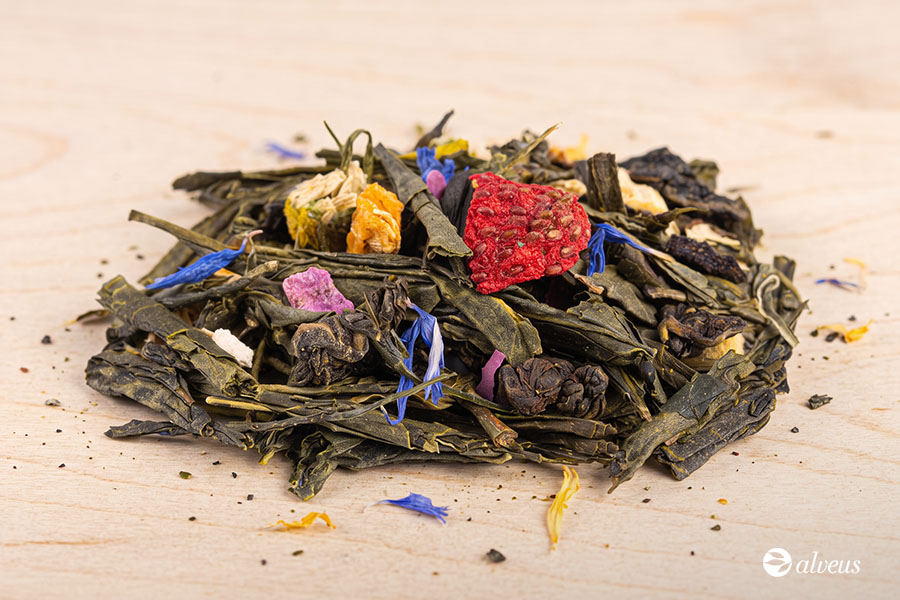
Strawberry Blush green tea – Ref. 83074 by Alveus
The combination of green tea and camomile is particularly interesting because both ingredients share a certain delicacy, even though they come from different aromatic worlds.
Green tea offers vegetal notes that can range from fresh grass and green leaves to sweeter, toasty or umami undertones, depending on its origin and processing. Camomile adds a warmer, fruitier floral dimension to this base.
The aim should not be to mask the character of the tea.
When the proportions are balanced, the flower softens the herbal perception and creates a more rounded sensation. Its apple-like notes can also act as a bridge to other ingredients such as citrus, flowers or fruits.
What does camomile bring to a rooibos blend?
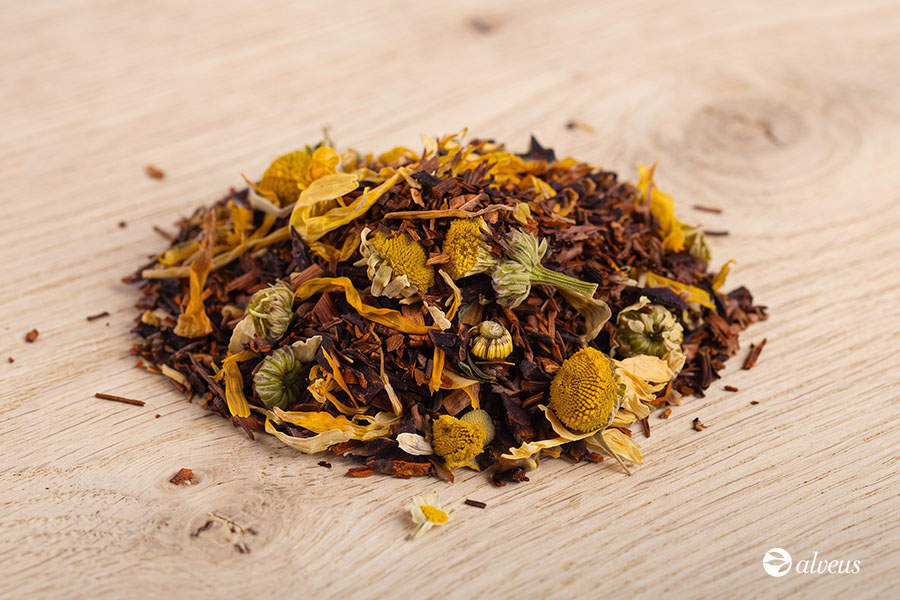
Rooibos offers a unique combination. Rooibos has a naturally sweet, woody and slightly honeyed profile. Camomile complements this base as it also brings sweet notes, whilst introducing a floral and fruity note that lends lightness to the blend.
Rather than creating contrast, as can happen with green tea, in a rooibos and camomile blend both ingredients tend to complement each other.
The apple-like notes of the flower can be enhanced with fruit, whilst its floral character pairs particularly well with vanilla, citrus, cinnamon, honey, lavender and other flowers.
It also offers interesting possibilities for developing caffeine-free blends, as neither rooibos nor camomile naturally contain caffeine.
Not all camomiles are the same: types of camomile
One of the most common misconceptions is to assume that any plant called ‘camomile’ is exactly the same.
This is not the case.
The species featured in this article is Matricaria chamomilla, also known as German camomile or sweet camomile. So-called Roman camomile belongs to another species, Chamaemelum nobile.
Both belong to the Asteraceae family, have similar flowers and a long history of use, which explains why there is some confusion between them. However, botanically they are different plants and do not have exactly the same aromatic composition either.
How to store camomile flowers
Dried flowers are sensitive to factors such as moisture, light, heat and prolonged exposure to air.
Proper storage helps to preserve both their appearance and their aromatic profile. It is advisable to store camomile in a cool, dry place, away from direct light and in properly sealed containers.
In bulk-sale businesses, it is also advisable to pay attention to product rotation and minimise unnecessarily prolonged exposure to the air. A flower that is visually attractive but virtually devoid of aroma loses much of the appeal that distinguishes a high-quality raw material.
Properties of camomile
amomile has a long tradition of use in Europe, particularly as a herbal tea. Much of this reputation has been passed down from generation to generation, although today we also have official bodies that have assessed its traditional uses.
The Committee on Herbal Medicinal Products of the European Medicines Agency (EMA) has specifically studied the flowers of Matricaria recutita, a synonym for Matricaria chamomilla. Its conclusions are based on what the EMA refers to as ‘traditional use’, that is, uses supported by long-standing practice and considered plausible and safe, but for which evidence from clinical trials is insufficient to establish a well-established medicinal use.
According to the EMA, traditional medicines made from camomile flowers have been used to:
- relieve the symptoms of mild gastrointestinal discomfort, such as bloating and minor cramps;
- relieve the symptoms of the common cold;
- treat minor ulcers and inflammation of the mouth and throat;
- complement the treatment of skin irritations and irritations of the anal and genital areas, once serious conditions have been ruled out by a doctor;
- treat mild skin inflammation, such as sunburn, as well as superficial wounds and small boils.
Source: EMA: https://www.ema.europa.eu/en/medicines/herbal/matricariae-flos
Not all of these uses, of course, involve drinking an infusion. Some refer to preparations for inhalation, rinses, topical applications or baths. In the case of camomile intended for drinking, the traditional use most directly related to this method of consumption is that associated with mild gastrointestinal discomfort such as bloating or minor cramps.
Contraindications and precautions for camomile
Although it is a widely consumed plant, ‘natural’ does not mean it is without precautions.
The EMA states that medicinal preparations containing camomile flowers should not be used by people with hypersensitivity or an allergy to camomile itself or to other plants in the Asteraceae or Compositae family. This family also includes plants such as calendula, echinacea and ragweed.
Furthermore, hypersensitivity reactions, including some severe allergic reactions, have been reported following contact between certain liquid camomile preparations and the mucous membranes, although the EMA notes that the frequency of these reactions is unknown.
Frequently asked questions about camomile
Are Matricaria chamomilla and Matricaria recutita the same thing?
Yes. Both names appear widely in botanical and technical literature. Kew Gardens currently considers Matricaria chamomilla L. to be the accepted name and Matricaria recutita L. to be a synonym.
Are German camomile and Roman camomile the same?
No. What is known as German camomile corresponds to Matricaria chamomilla, whilst Roman camomile is Chamaemelum nobile. They are different species, although they share certain visual and aromatic similarities.
What does camomile taste like?
It has a mild, floral and slightly herbaceous flavour, with a natural sweetness and a characteristic hint of apple. Depending on the strength and steeping time, a slight bitter note may also be present.
Does camomile contain caffeine?
Camomile does not naturally contain caffeine. An infusion made solely from its flowers is therefore naturally caffeine-free. If it forms part of a blend with green tea, black tea or another tea derived from Camellia sinensis, the blend will contain caffeine.
Which part of the camomile plant is used to make infusions?
The dried flower heads are mainly used. It is precisely this part of the plant that contains most of the aromatic compounds responsible for its characteristic flavour profile.
What ingredients does camomile go well with?
Its floral and slightly sweet character allows it to be combined with a wide variety of ingredients. Citrus fruits, lemongrass, verbena, fennel, cinnamon, apple, vanilla, lavender and other flowers are just some of the possibilities. The choice depends on whether you wish to keep camomile as the star of the show or use it to add roundness and floral notes to the blend.